Preferred deals
Preferred deals are a type of programmatic advertising agreement that allows publishers to offer inventory to specific advertisers before making it available on the open market.
What are Preferred deals?
Preferred deals are direct agreements between publishers and advertisers where inventory prices are set in advance, and the inventory is offered to the advertiser before entering the broader programmatic bidding process. This setup ensures advertisers get access to high-quality, targeted inventory without competing in real-time bidding (RTB), while publishers can secure revenue from trusted advertisers at predetermined prices.
Preferred deals vs. other Programmatic deals
First of all, it is advisable to start with the overall picture as follows
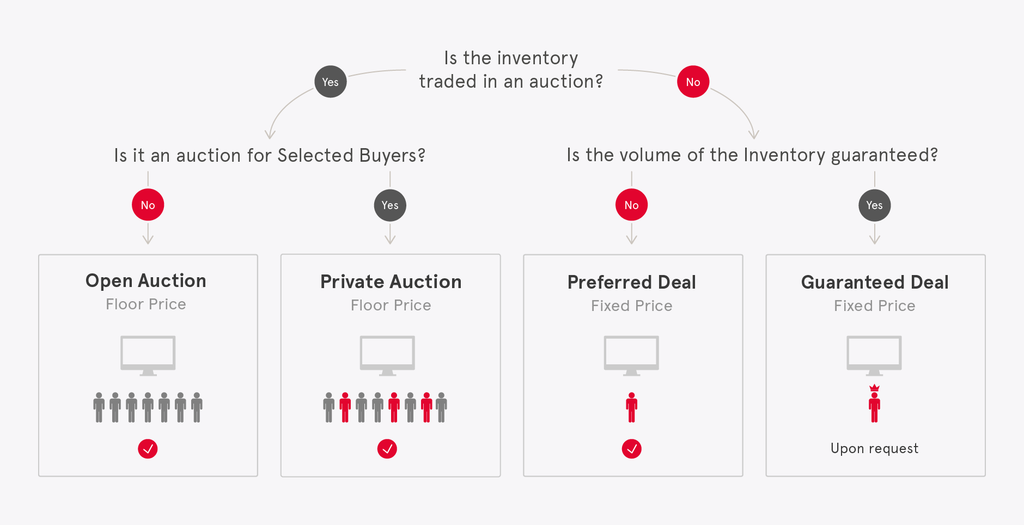
Obviously, there are 4 main types of Deals. Here is a short summary of what they do:
- Preferred Deals offer advertisers first look at inventory at a fixed price without the obligation to buy, allowing for flexibility and access to premium inventory without competition.
- Private Auctions involve a selected group of advertisers bidding on inventory at a minimum price set by the publisher. Unlike preferred deals, advertisers compete in a closed environment.
- Programmatic Guaranteed deals secure inventory for advertisers at a fixed price, with guaranteed impressions. Unlike preferred deals, there is a commitment from both sides—the publisher guarantees the inventory, and the advertiser commits to buying it.
- Open Auctions allow widespread, real-time bidding on ad inventory, offering extensive reach and efficiency. However, this model poses higher risks of ad fraud, reduced control over ad placements, and challenges in data privacy and security compared to more controlled approaches like Preferred Deals. Despite potential concerns, Open Auctions are favored for their ability to maximize reach and inventory monetization.
How Does Preferred Deals Work?
Preferred deals can be initiated by publishers or advertisers. Either way, the process will look like this:
- Negotiation: Publishers and advertisers negotiate the terms of the deal, including pricing and inventory specifics.
- Setup: The deal is set up in a Demand-Side Platform (DSP) and a Supply-Side Platform (SSP) or an ad exchange, using a unique deal ID.
- First Look: When the specified inventory becomes available, the advertiser is given the first opportunity to purchase it at the agreed price.
- Purchase Decision: The advertiser can decide to buy the offered inventory. If declined, the inventory moves to the next tier of sales, often to private auctions or the open marketplace.
- Reporting and Optimization: Both parties track performance through their respective platforms and adjust strategies for future deals.
Why are Preferred Deals Important?
Price Clarity and Stability
The negotiation aspect of Preferred Deals sets a clear, fixed price for the inventory, eliminating the unpredictability associated with the auction dynamics of the open market. For advertisers, this means better budget control and for publishers, a guaranteed revenue for their premium spots. This pricing model benefits both parties by providing stability in a fluctuating market.
First-Mover Advantage
For advertisers, securing a Preferred Deal means getting a 'first look' at premium inventory before it's made available in the open market or through private auctions. This first-mover advantage allows advertisers to capitalize on unique opportunities that align closely with their campaign objectives, potentially leading to higher conversion rates and better overall campaign performance.
Reduced Ad Fraud Potential
Preferred Deals allow publishers to sell inventory directly to trusted advertisers, bypassing the open auction environment where fraudulent actors are more prevalent. This direct selling model can significantly reduce the risk of ad fraud, such as fake impressions or click fraud, ensuring that ad spend goes towards genuine engagement.
Put these concepts into practice
See how Airbridge helps teams implement mobile attribution strategies at scale.