IP Address
An IP (Internet Protocol) address is a distinctive numerical label assigned to each device connected to a network using the Internet Protocol, identifying its physical location.
What is an IP Address?
An IP (Internet Protocol) address is a unique string of numbers separated by periods (IPv4) or colons (IPv6) that identifies each device using the Internet Protocol to communicate over a network. It allows devices to send and receive data, ensuring that the information reaches the correct destination.
The components of an IP Address?
An IP address consists of two main components: the network identifier and the host identifier. The network part specifies the unique network on the internet, while the host part identifies the specific device within that network.
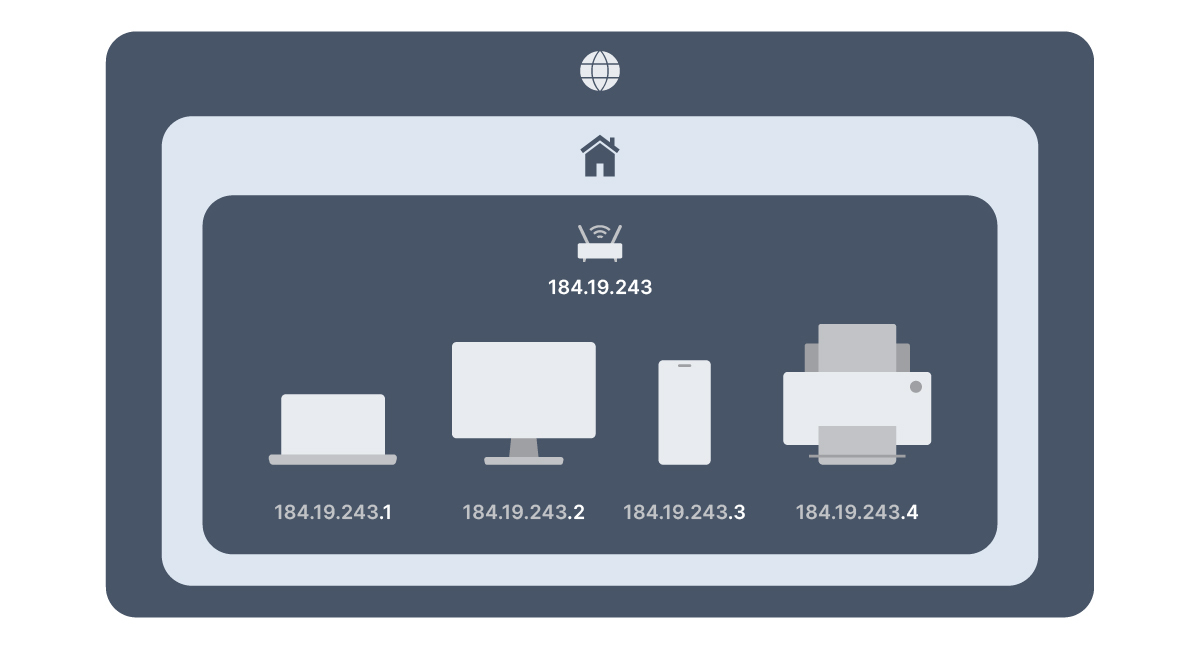
In the example above, your 4 devices using the same internet connection have the same part “184.19.243” which is the network identifier. The last part, “1” - “2” - “3” or “4”, is the host identifier.
Different Types of IP Addresses
- Public vs. Private IP Addresses: Public IP addresses are used on the internet, making devices accessible globally, whereas private IP addresses are used within private networks, offering security and limiting external access.
- Static vs. Dynamic IP Addresses: Static IP addresses remain constant, offering a permanent address for hosting websites or services, while dynamic IP addresses can change with each connection to the internet, provided by ISPs for general consumer use.
- IPv4 vs. IPv6: As mentioned above, although iPv6 is more advanced and slowly replacing iPv4, it is worth mentioning that the iPv4 structure is still more commonly used by the majority of global devices.
How are IP Addresses used in App Marketing?
IP Targeting Advertising, a type of paid media, has always been one of the best strategies in App Marketing. In this respect, Geofencing and Geotargeting are the two most popular practices.
- Geofencing creates a virtual boundary around a geographical area, allowing for the delivery of targeted marketing messages to users within this perimeter. It's highly effective for local promotions and in-app notifications based on real-time location.
- Geotargeting involves delivering content or advertisements to users based on their general geographic location derived from their IP address. It's used for broader targeting, such as regional offers or content customization.
While IP Address can provide the general location information of users, it can not show the exact location like home addresses. Still, IP address advertising is now more limited, as users have multiple methods like VPN or iCloud Private Relay to limit IP tracking. Furthermore, with the advent of SKAdNetwork (SKAN) by Apple, advertisers can not receive device IP addresses in SKAN postbacks anymore.
IP Address vs Airbridge
While it is getting harder to work with IP Address in this privacy-first era, Airbridge has a solution for advertisers. By using Airbridge SDK, advertisers can still collect Airbridge Device ID through a universally unique identifier (UUID) and also receive datas from the partners. Users can also be better targeted with the help of Google Advertising ID (GAID) and Identifier for Advertiser (IDFA) from Airbridge dashboard.
To learn more about what you can do with Airbridge, please visit here.
Put these concepts into practice
See how Airbridge helps teams implement mobile attribution strategies at scale.