Data Management Platform (DMP)
A Data Management Platform (DMP) collects, organizes, and activates first, second, and third-party audience data from any source, including online, offline, mobile, and beyond.
What is a Data Management Platform (DMP)?
DMPs serve as centralized data warehouses for marketers and advertisers, allowing for the storage, analysis, and management of vast amounts of information regarding audiences and customer interactions. In the mobile landscape, this translates to an enhanced understanding of user behavior across apps and websites, enabling more targeted and effective advertising strategies.
DMPs can get data from multiple sources, such as:
- Website data
- Mobile data
- App data
- Smart TV data
- CRM Software data
- Social Media data
But wait, doesn’t it sound like Customer Data Platform (CDP)? Let’s find out more about the difference in the section below.
Difference Between a DMP and a Customer Data Platform (CDP)
While both DMPs and CDPs collect and organize data, their core functions and purposes differ. DMPs primarily focus on anonymous audience data for broad targeting and advertising purposes, often using cookies for tracking. CDPs, on the other hand, collect, store, and manage personally identifiable information (PII), creating a comprehensive, unified customer database that is used for more personalized marketing efforts.
Besides, DMPs often store third-party data, which is often anonymized as third-party cookies can’t cover cross-device information like multiple email addresses or detailed behaviors. CDPs often store first-party data, and unify scattered cross-platform data into a single user identifier.
How Does a DMP Work?
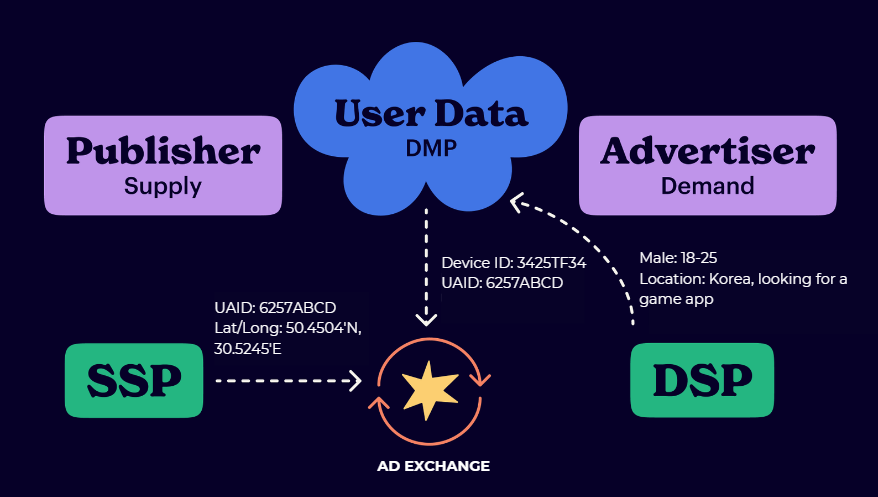
Let’s take a look at the process from an advertiser’s perspective:
- Step 1: You, an advertiser, want to target males aged 18-25, located in Korea, who recently searched for a game app. You will set these criteria in your Demand-side platforms (DSP), which marks the start of the process
- Step 2: The DSP then comes to a DMP for data
- Step 3: The DMP searches for users with the same criteria as the DSP stated
- Step 4: Upon matching, the DMP forms a Device ID or a Unique Advertising ID (a special ID code that contains the advertiser’s request about a user)
- Step 5: The requested ID goes to an ad exchange, and the programmatic auction happens. At this stage, you can see an ad placement.
Or to simplify the whole process, you can use MMPs like Airbridge which integrates with such DMPs as Segment. Therefore, Airbridge users can view DMPs events in the Airbridge reports, all in a unified dashboard.
What are the features to expect in a DMP
Integrating Advertising Data
Integrating advertising data involves gathering and utilizing information from various sources, both online and offline. This process includes:
- Collecting first-party data across devices and offline channels.
- Segmenting this data into groups for targeted advertising.
- Expanding audience reach using data marketplaces to include second- and third-party data.
- Monitoring the data collection process and addressing any issues.
- Tracking the identification and segmentation of user profiles.
- Analyzing trends in ad inventory.
Building Target Audiences
Effective audience building targets the right users and broadens the reach to optimal audience segments by:
- Employing look-alike modeling to find new potential customers.
- Sharing second-party data with controlled permissions.
- Utilizing audience discovery reports to identify relevant audience classifications.
- Expanding existing target audiences or discovering new ones to boost campaign performance.
Cross-device Targeting
To deliver coherent marketing campaigns across multiple devices, it's essential to:
- Incorporate third-party data to widen audience reach across channels and devices.
- Utilize private ID graphs for enhanced cross-device targeting.
- Target prospects on various web and social platforms through cross-device strategies.
Analyzing Audiences
Understanding the performance of marketing campaigns and identifying the most effective devices for conversion involves:
- Gaining insights into your audience with detailed analytics reports.
- Leveraging pre-campaign analytics to define your audience before launching campaigns.
- Evaluating campaign targeting precision with post-campaign analysis.
- Employing audience suppression to exclude users who have already converted.
Put these concepts into practice
See how Airbridge helps teams implement mobile attribution strategies at scale.