MMP Numbers Don't Match Your Ad Platform? Here's What It's Costing Your Subscription Funnel
Your MMP (Mobile Measurement Partner) says Meta drove 200 paid subscribers last month. RevenueCat says 140. Meta Ads Manager claims 310. Three systems, three numbers, zero confidence in which one should guide your next budget decision.
This is not a reporting inconvenience. For subscription apps spending $5,000 to $20,000 per month on paid acquisition, misattributed numbers directly distort CAC calculations, corrupt channel-level ROAS, and cause budget to flow toward campaigns that appear profitable but are not. The cost compounds monthly because the same flawed data drives the same flawed decisions.
Key Takeaways
- Subscription apps face the widest attribution gaps. Revenue events happen days or weeks after install, often outside the ad platform's default optimization window.
- Ad platforms routinely over-report conversions compared to actual revenue data. When each platform claims credit for the same user, the sum of reported conversions exceeds reality, making channel-level budget decisions unreliable without a reconciled source of truth.
- The financial cost is tangible. Growth teams spend 4-8 hours per week on manual data stitching, and misallocated budget on channels that look profitable in platform dashboards compounds quarter over quarter.
- Airbridge Core Plan closes this gap by connecting install attribution to subscription revenue through native RevenueCat and Adapty integrations, with 25 standard subscription events tracked across Meta, Google, Apple Search Ads, and TikTok.
Why MMP Numbers Never Match Your Ad Platform Data
The mismatch between your ad platform, your MMP, and your billing system is not a bug. It is the predictable result of three independent systems measuring overlapping but different things with incompatible rules.
For subscription apps, this problem is worse than for most app categories. The revenue event that actually matters (a paid subscription) happens days or weeks after the install. By the time a user converts from trial to paid subscriber, the attribution window may have already closed on one or more platforms.
Understanding what MMP attribution numbers mismatch costs subscription apps starts with knowing why these numbers diverge in the first place.
1. Self-Reporting Networks Inflate Conversions by Design
Self-Attributing Networks (SANs) like Meta, Google, and TikTok each report their own conversion numbers using their own attribution models. Meta may count a view-through conversion within a 1-day window. Google may attribute the same install to a search click within a 30-day window. TikTok may claim that same user through its own click model.
The result: the same user gets counted by multiple platforms. Independent analysis shows that major ad platforms systematically over-report conversions, with Meta over-reporting by a median of 134% and Google by approximately 18% (Cassandra, 2025). Your MMP applies a single attribution model to deduplicate these overlapping claims, which means the MMP's total will almost always be lower than the combined platform numbers.
Growth teams reviewing both dashboards see the discrepancy and lose trust in both data sources. The real problem is not that the numbers differ. It is that neither set of numbers connects to actual subscription revenue.
2. Attribution Windows Create Structural Gaps
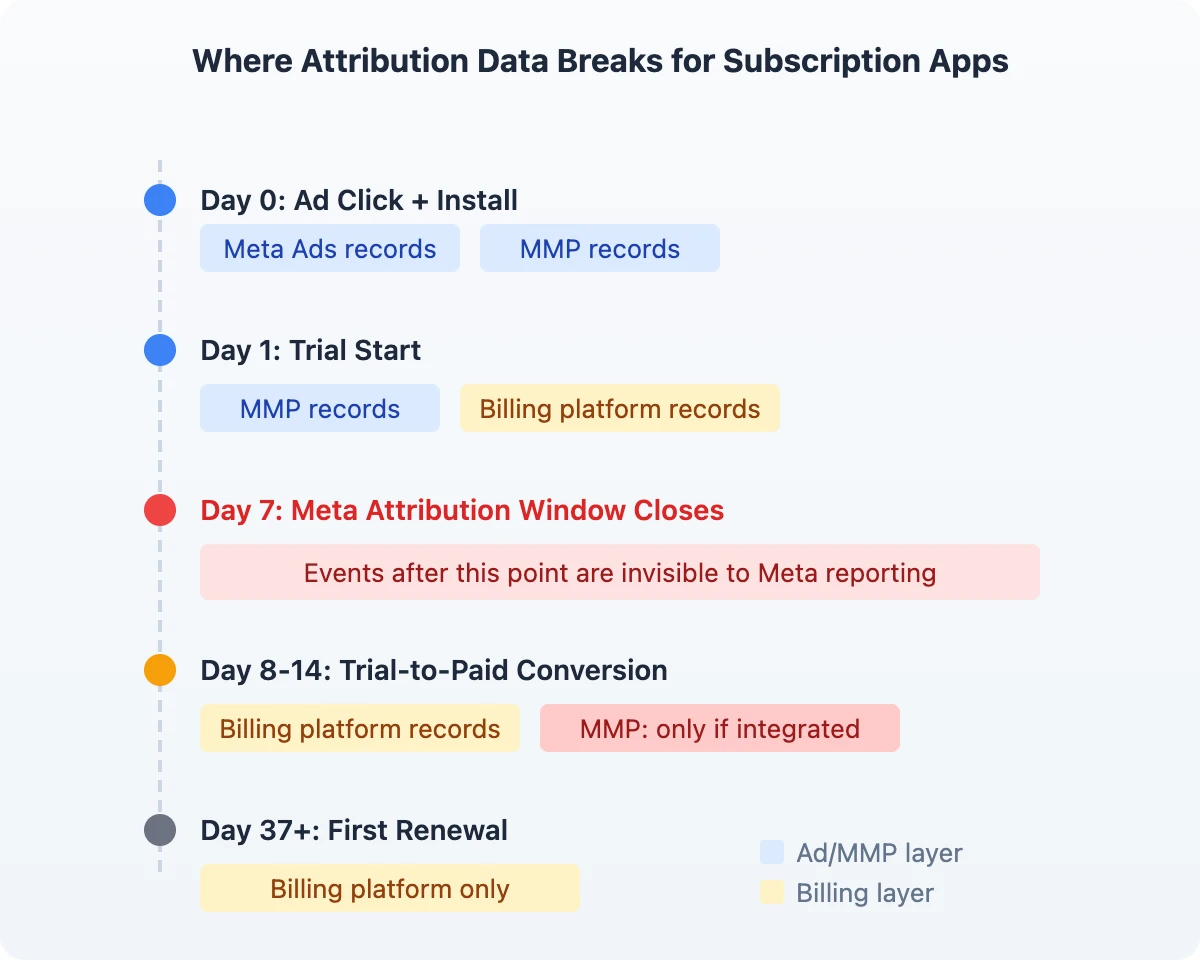
Consider this standard timeline for a health and fitness subscription app:
| Event | Timing | Who Records It |
|---|---|---|
| Ad click (Meta) | Day 0 | Meta Ads, MMP |
| App install | Day 0 | MMP |
| Trial start | Day 1 | MMP, Billing platform |
| Trial-to-paid conversion | Day 7-14 | Billing platform |
| First renewal | Day 37-44 | Billing platform only |
Meta's default click attribution window is 7-day click. If a user starts a 7-day free trial on Day 1 and converts to paid on Day 8, Meta may not count the subscription as a conversion from that click. Your MMP records the install but may lack the subscription event unless it is integrated with your billing platform. RevenueCat records the subscription but has no channel attribution data.
Each system captures part of the picture. None captures the complete path from ad click to subscription revenue. The gap between "attributed installs" and "actual subscribers" is where budget decisions go wrong.
3. The Subscription Timing Problem
For health and fitness apps, this timing gap is especially costly. January resolution spikes drive the highest install and trial volumes of the year. But the churn wave hits in February and March, separating high-intent subscribers from impulse sign-ups.
If attribution data lags by even two weeks, growth teams cannot distinguish which January campaigns drove subscribers who renewed versus those who cancelled after the trial. According to RevenueCat's State of Subscription Apps 2025 report, 67% of Health and Fitness subscription revenue comes from annual plans, and Health and Fitness apps see a median trial-to-paid conversion rate of 39.9%. Missing the January optimization window means waiting a full year for the next comparable acquisition opportunity.
The cost is not abstract. A team spending $15,000 per month on paid UA that scales the wrong channel for two months because attribution data was stale has wasted $10,000-$15,000 on campaigns that produced trial starts but not paying subscribers.
4. The Manual Reconciliation Tax
Without automated attribution-to-billing integration, most growth teams fill the gap with spreadsheet exports. The typical workflow: export MMP install data weekly, export RevenueCat subscription data weekly, manually match user IDs or campaign tags, and flag discrepancies.
Over a year, that is 200-400 hours of growth team time spent on data hygiene instead of campaign optimization. Worse, the manual process introduces its own errors. Campaign naming inconsistencies, timezone mismatches between export files, and lag between systems mean the reconciled numbers are still approximations.
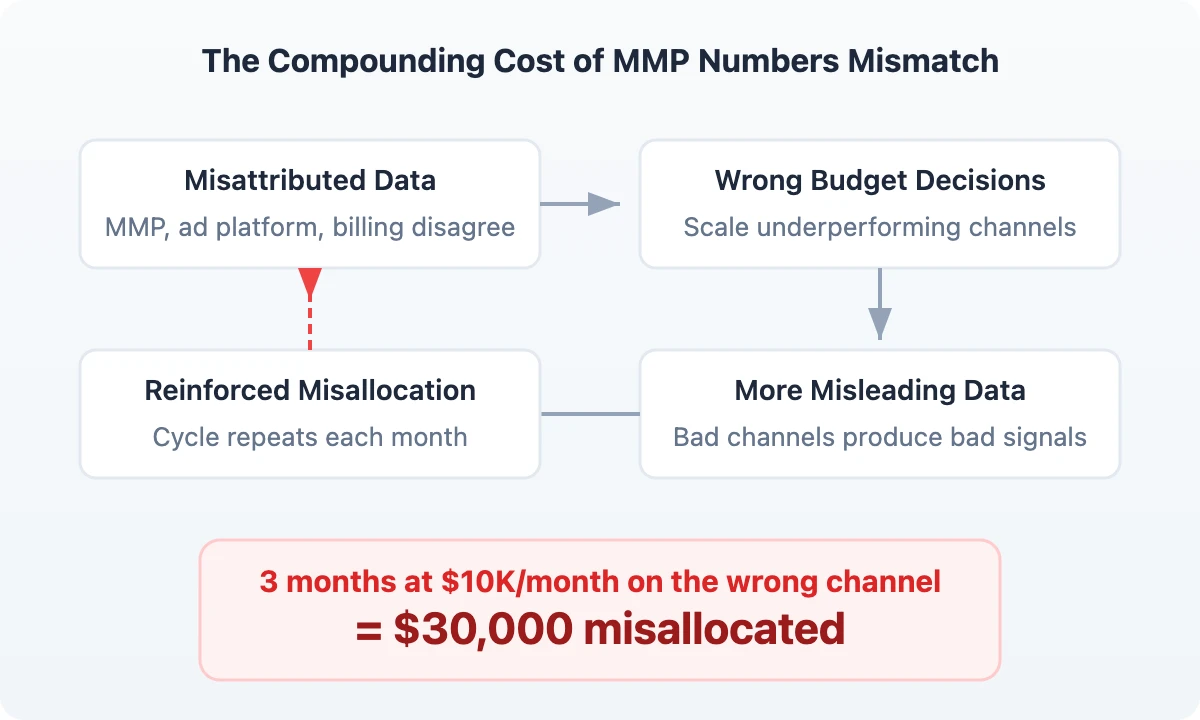
The compounding effect is what makes MMP numbers mismatch so expensive for subscription apps. Misattributed data leads to wrong budget decisions. Wrong budget decisions produce more misleading data in the next cycle. A team that scales the wrong Meta campaign for three months at $10,000 per month has misallocated $30,000 before the reconciliation report even catches the discrepancy.
%%CTA|Try It Free|https://app.airbridge.io/signin?from=blog-inline|Stop guessing which numbers are right — unify your attribution data.%%
Start measuring what matters — for free
Airbridge Core Plan gives growing teams real attribution, deep linking, and audience tools at no cost.
Get Started Free →How to Reduce Attribution Mismatch and Recover Lost Budget
1. Practical Steps to Minimize Data Gaps
Before adopting any new tool, growth teams can take immediate steps to reduce the noise in their attribution data:
- Align attribution windows across all ad platforms to the same lookback period. If Meta uses 7-day click and Google uses 30-day click, your cross-channel comparison is inherently skewed. Standardize to the window that matches your typical trial-to-paid conversion timeline.
- Establish one system as the revenue source of truth. RevenueCat or Adapty should be the single authority for subscription revenue data. Do not use ad platform revenue reporting for budget allocation decisions.
- Run weekly reconciliation between MMP install data and billing platform subscription data. Flag channels where the gap between attributed installs and actual subscriptions exceeds 20%.
- Tag campaigns with consistent UTM structures so that manual matching between systems is at least possible when automated attribution breaks down.
- Prioritize trial-to-paid conversion rate by channel over install volume as the primary budget signal. A channel with fewer installs but higher subscription conversion is more valuable than one with high install volume and low paid conversion.
These steps reduce noise and improve decision quality. But they do not eliminate the structural gap between install attribution and subscription revenue. Closing that gap requires a system that connects attribution data to billing data natively.
2. How Airbridge Core Plan Closes the Subscription Attribution Gap
Airbridge Core Plan was built around one question: "Are paid users converting into subscriptions, and which channels are driving value?"
For teams frustrated by MMP numbers that never reconcile with billing data, Core Plan addresses the structural gap directly:
Native billing platform integration. Core Plan integrates with RevenueCat and Adapty at the base tier. Most enterprise MMPs include these integrations in higher-tier plans. Core Plan includes them from day one at no extra tier, eliminating the manual reconciliation workflow.
25 standard subscription events. Core Plan tracks the full subscription lifecycle with predefined events: Install, Start Trial, Subscribe, Unsubscribe, and Order Complete, among others. These standard events use predefined event names and parameters defined by Airbridge, reducing schema design work compared to building custom event taxonomies from scratch.
Single attribution source across GMAT channels. Core Plan deduplicates installs and events across Meta, Google, Apple Search Ads, and TikTok, providing one consistent attribution view instead of four conflicting platform reports. These four channels typically represent 80-90% of early-stage paid acquisition spend.
Six built-in reports for subscription analytics. Funnel, Retention, Revenue, Actuals, Trend, and Active User reports surface channel-level subscription performance without requiring a data warehouse or custom dashboard.
| Capability | Enterprise MMP | Airbridge Core Plan |
|---|---|---|
| Billing integration (RevenueCat, Adapty) | Native (included in higher tiers) | Native (included in base) |
| Subscription events | Predefined + custom events | 25 subscription-optimized standard events |
| Setup guidance | General-purpose | Subscription-app focused |
| Minimum contract | Annual, $10K+ | Pay-as-you-go, 15K free installs |
| Unnecessary features | Fraud, raw export, agency access included | Intentionally removed |
Pricing designed for early-stage budgets. Core Plan starts with 15K free attributed installs and charges $0.05 per install after that. Compare this to enterprise MMPs that typically require annual contracts with minimum commitments of $10,000 or more. For a team spending $5,000-$20,000 per month on paid UA, the attribution tool should not cost more than a meaningful percentage of the ad budget itself.
Design trade-offs, stated honestly. Core Plan does not support custom events. For subscription apps using standard trial and payment flows, the 25 predefined events cover the funnel without schema planning. Core Plan supports a maximum of 2 third-party integrations and GMAT channels only. If your team requires custom event tracking beyond standard subscription events, or integrations with non-SAN ad networks, Airbridge's Growth Plan provides those capabilities.
FAQ: MMP Numbers Mismatch and Subscription Attribution
How much budget can attribution mismatches waste?
For a team spending $10,000-$20,000 per month across 3-4 channels, even a 20% misallocation means $2,000-$4,000 per month directed to the wrong campaigns. Over a quarter, that totals $6,000-$12,000 in misallocated spend.
What causes the biggest discrepancy between MMP and ad platform numbers?
The largest gap comes from Self-Attributing Networks counting the same conversion across platforms. View-through attribution and different lookback windows compound the problem. For subscription apps, the delay between install and paid conversion amplifies the gap because the revenue event often falls outside the ad platform's attribution window. The MMP deduplicates installs but often lacks direct billing data, creating a second gap between attributed installs and actual revenue.
Every Dollar Misattributed Is a Dollar Misallocated
The gap between what your ad platforms report, what your MMP records, and what your billing system confirms is not just a data problem. It is a structural blind spot that compounds with every month you scale spend without reconciled attribution.
For subscription apps where the revenue event happens days or weeks after the install, this gap is wider than for any other app category. Growth teams that operate without channel-level subscription attribution do not just misallocate budget. They systematically underfund the channels that produce their highest-value subscribers.
Start Free with Airbridge Core Plan and connect install attribution to subscription revenue, starting with 15K free attributed installs.