[Deep Link 101] Using Deferred Deep Linking to Direct Users Without the App to a Specific In-App Page
![[Deep Link 101] Using Deferred Deep Linking to Direct Users Without the App to a Specific In-App Page](/_next/image?url=%2Fimages%2Fcms%2Fblog%2Fdeeplink-101-deferred-deep-linking-ko.webp&w=1920&q=75&dpl=dpl_6HPBkTW2n9fAA4udk6PEH7UqJkXG)

Want to direct users to a relevant in-app page even after they click a link and install your app? If so, you need deferred deep linking.
For more details about deep links, check out the <Airbridge Handbook - Deep Links> guide.
What Is Deferred Deep Linking?
Deferred deep linking is a technology that extends the capabilities of standard deep links. As the name suggests, it means a "delayed deep link." Since deep linking cannot work for users who don't have the app installed, this technology waits until the user clicks a link, installs the app, and opens it — then executes the deep link. Implementing this on your own is not easy because it requires a server that can store and deliver the deep link, as well as match the information from when the user clicked the link with the information of the user who installed and opened the app.
In this post, learn why deferred deep linking technology is necessary and how to implement it.
Why Is Deferred Deep Linking Necessary?
A deep link is a technology that, when a user in a mobile environment clicks a link, launches the app and navigates to a specific page. In other words, it's a link with a designated path leading into the app. However, if the app is not installed when a deep link is clicked, the user is either redirected to the app store or encounters an error, and the link/path doesn't work properly. This means that even a user who clicks a deep link won't be directed to a specific in-app page.
Specifically, when the app is not installed, the following issues can occur:
-
When using URI Scheme deep links, if the app is not installed, it's impossible to navigate to another destination such as the app store, so nothing happens at all.
-
In the case of Universal Links and App Links, it's not possible to use URLs that land directly on the App Store or Google Play, making it difficult to even prompt users without the app to install it.
-
To address these situations, using only deep links through an MMP's tracking links still doesn't provide a complete user experience.
Due to these functional limitations, if nothing happens after an ad click, or if after the cumbersome process of installing the app only the main page appears, even potential customers who were attracted by the ad may immediately drop off.
The technology that solves this problem is deferred deep linking.
Even for users who don't have the app installed, if they see an ad and install the app, it feels natural to be directed to the relevant content within the app after installation. The likelihood of conversion increases as well. This is exactly why deferred deep linking is essential for app marketing.
How to Implement Deferred Deep Linking
However, implementing deferred deep linking technology on your own can present several challenges. At the Android OS level, it can be implemented using the Google Play Install Referrer API, but with limitations. Moreover, on iOS, there is no OS-level method for implementing deferred deep linking, so a complex setup such as building a separate server is required.
The Difficulty of Implementing Deferred Deep Linking In-House
First, on Android, you can implement deferred deep linking independently using the Google Play Store's Google Play Install Referrer API.
However, this method is complex to implement, making data collection issues highly likely, and it only works for downloads from Google Play.
On iOS, a similar approach is not possible, so building a server is an additional step that becomes necessary.
Easily Implement Deferred Deep Linking with a Mobile Attribution Solution
Given that deferred deep linking is difficult to implement on your own, how can you do it efficiently and completely? The answer is to use a solution provided by a mobile attribution tool.
Deferred deep linking is a technology that delays the deep link until the user clicks a link, installs the app, and opens it. A server is needed that can store the user's click information and, when the app is launched, match the click data with the user who opened the app and deliver the deep link. This is what an attribution tool provides.
The process of implementing deferred deep linking through Airbridge:
- User clicks an Airbridge tracking link -> Click information stored on server -> User installs the app -> On first launch of the app with SDK integrated, the server checks for link information -> Server delivers the deep link address to the SDK -> The specific in-app page is opened
SDK Guides:
- Airbridge Android SDK guide
- Airbridge iOS SDK guide
Airbridge Tracking Links Make Deferred Deep Linking Easy to Apply
With Airbridge, when you set up a tracking link as a deep link, the deferred deep linking feature is enabled by default.
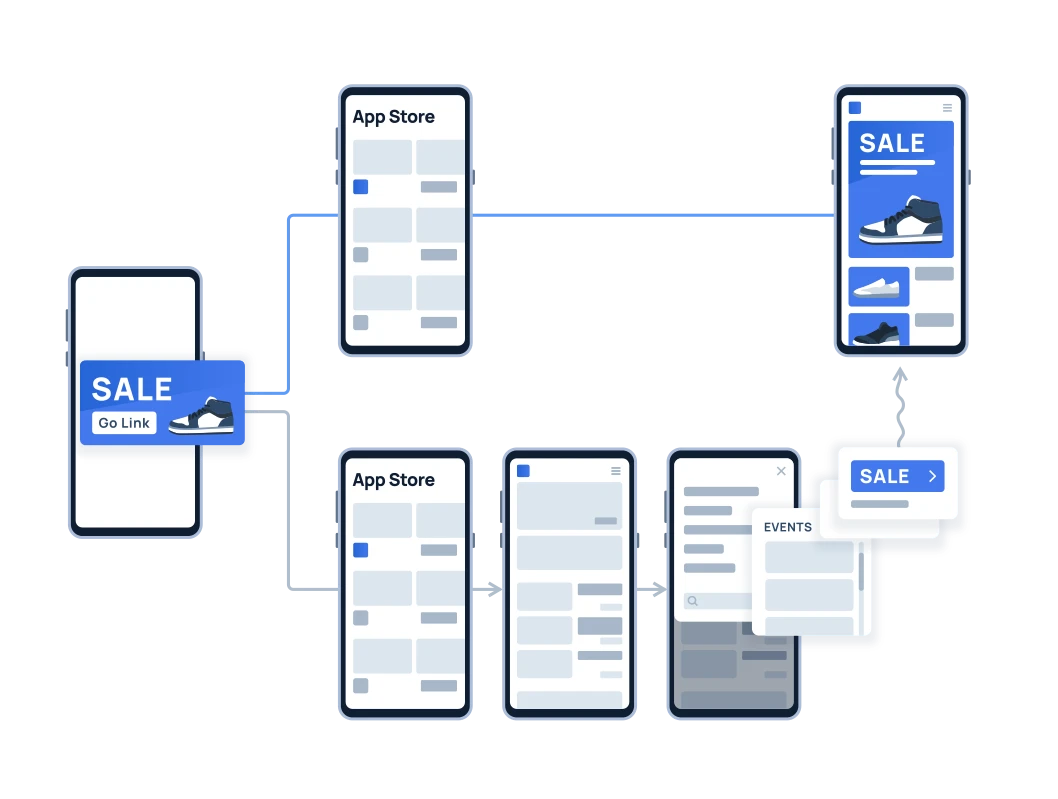
For Smooth App Marketing, It's Best to Use an MMP's Tracking Links
MMP tracking links let you design the user journey you want without complex per-OS implementation.
Deferred deep linking is an essential technology for app marketing. Implement it efficiently using Airbridge tracking links.
Check out other articles in the Deep Link 101 series: 👉 Deep Link 101: Getting Started with Deep Links for Marketers and Developers 👉 Deep Link 101: Why Does a Warning Message Appear When Deep Linking in iOS Safari?
Ready to transform your mobile growth?
Learn how Airbridge helps leading brands measure and optimize every touchpoint.