Install, Trial, Subscribe: Which Conversion Event Should Your Fitness App Send to Each Ad Platform?
9 min read
Share
Your fitness app generates 200 trial starts per week. That is enough volume for Meta to optimize. But only 70 of those convert to paid subscribers — spread across 4 ad sets, that is 17 Subscribe events per ad set per week. Meta needs 50.
So you optimize for Start Trial instead. The algorithm gets enough data. Trial volume grows. But trial-to-paid keeps falling — because the algorithm is finding users who start trials, not users who subscribe.
This is the core tension of app event optimization for fitness apps: deeper funnel events carry better signal, but they often fall below the volume threshold that ad platforms need to learn.
Key Takeaways
- The event you optimize for is the user you get. Send Install events, the algorithm finds installers. Send Subscribe events, it finds subscribers — but only if volume is sufficient.
- Each platform has different volume thresholds. Meta: ~50 conversions/ad set/week. Google: ~10 events/day/campaign. TikTok: 50 conversions or 7 days.
- The sweet spot for most fitness apps is the Qualified Trial — deep enough for strong signal, high enough volume for algorithm learning.
- The optimal event differs by platform. Your Meta event strategy and your Google event strategy should not be identical.
- Airbridge Core Plan shows Install → Trial → Subscribe conversion rates by channel — so you can validate whether your event strategy is driving actual subscribers, not just the event you optimized for. Start with 15K free attributed installs.
The Event You Optimize For Is the User You Get
When you select a conversion event for app event optimization, you are not just choosing a metric to track. You are telling the algorithm which users to find more of.
Volume vs Intent: The Core Tradeoff
Every conversion event sits on a spectrum. Shallow events (Install, App Open) generate high volume but carry weak intent signal. Deep events (Subscribe, Renewal) carry the strongest signal but generate the least volume.
Ad platforms need minimum conversion volume to learn. Below that threshold, the algorithm cannot identify patterns in who converts — delivery becomes erratic, CPAs spike, and the ad set enters a state Meta calls "Learning Limited."
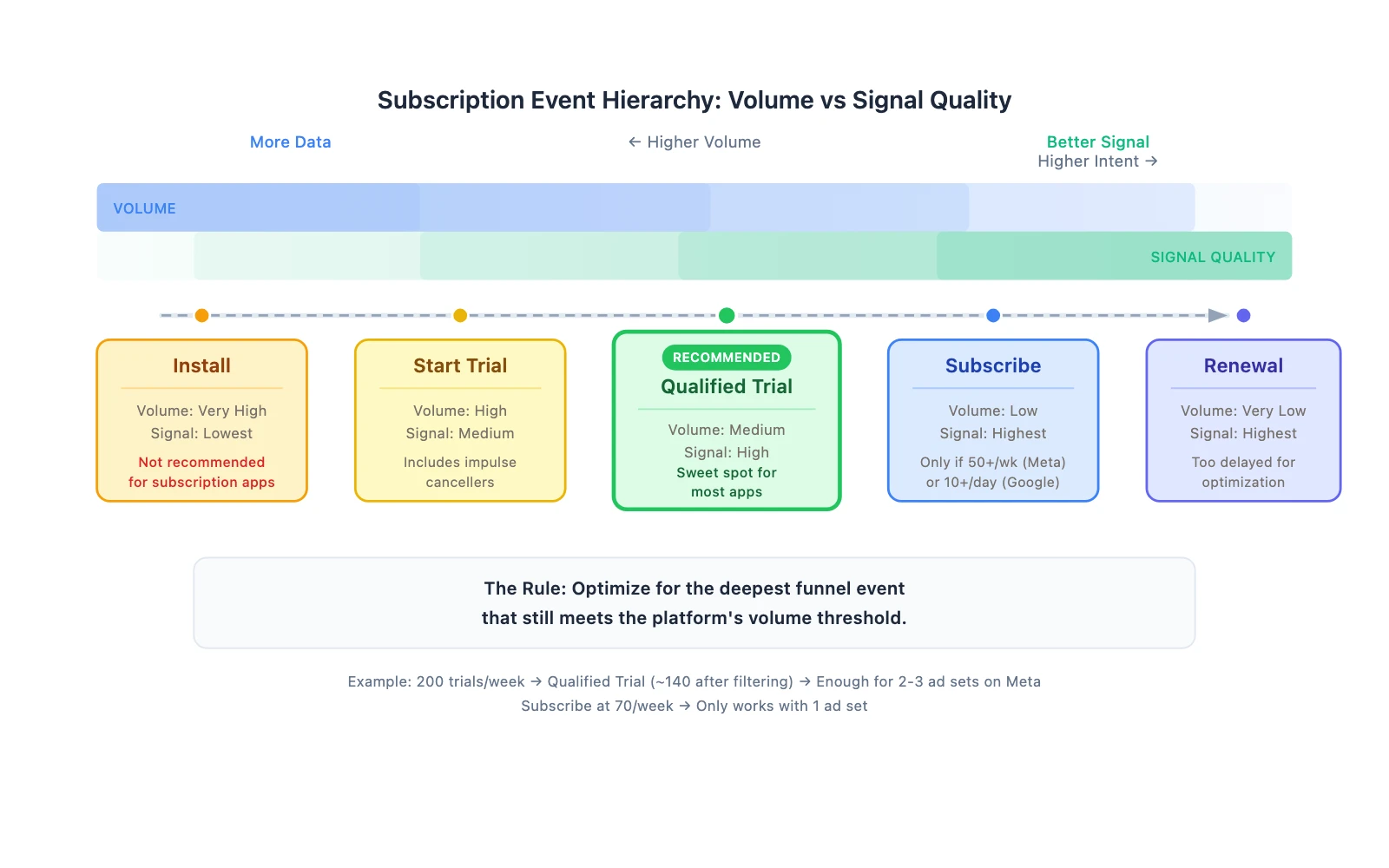
The tradeoff: optimize for a shallow event and the algorithm learns fast but learns the wrong lesson. Optimize for a deep event and the algorithm learns the right lesson but may never learn at all.
What Happens When You Optimize for the Wrong Event
A fitness app optimizing for Install on Google will attract users who download the app — many of whom never open it, never start a trial, and never consider subscribing. The algorithm delivered exactly what you asked for: installs. It just never learned what a subscriber looks like.
Conversely, optimizing for Subscribe on Meta with only 12 events per ad set per week means the algorithm never exits the learning phase. It cannot build a reliable profile of who subscribes. You are sending the right signal, but not enough of it.
The fix is not choosing between volume and intent. It is finding the deepest event that still meets the platform's volume threshold — and that event is different for each platform.
Platform-by-Platform: What Each Algorithm Needs
Meta: 50 Conversions per Ad Set per Week
Meta's optimization tiers for fitness apps:
- MAI (Mobile App Install): Optimizes for install volume. Cheapest CPI, weakest subscriber quality. Not recommended as primary optimization for fitness apps.
- AEO (App Event Optimization): Optimizes for a specific in-app event — Start Trial, Subscribe, or a qualified trial. Best when you have enough event volume at a specific funnel stage.
- VO (Value Optimization): Optimizes for conversion value/ROAS. Requires at least 30 attributed purchases with 5+ distinct values over 14 days.
The critical threshold: 50 conversions per ad set per week to exit the learning phase. Below this, the ad set enters "Learning Limited" status — delivery destabilizes and CPAs spike. The learning phase typically lasts 3-7 days.
For most fitness apps: Start with AEO on Qualified Trial. Graduate to VO when you consistently hit 30+ purchases/week with 5+ distinct values.
Google: 10 Events per Day per Campaign
Google App Campaigns work differently from Meta. The main optimization paths:
- tCPA (target Cost per Action): Set a target cost per trial start or subscription. Standard for most fitness apps. Budget minimum: 10x your target CPA.
- tROAS (target Return on Ad Spend): Optimizes for conversion value. Requires sufficient purchase/revenue data via Firebase. Best for apps with varied subscription tiers.
Google needs approximately 10 in-app events per day per campaign for optimal learning. Even 5 events/day can work — but fewer than that, and the algorithm struggles.
For most fitness apps: Use Trial Started as the core conversion event with tCPA. This generates enough volume for Google's algorithm while correlating to subscription intent. Graduate to tROAS when you have sufficient revenue data flowing through Firebase.
TikTok: 50 Conversions or 7 Days
TikTok's AEO finds users who will install AND perform a specific in-app event. The learning phase runs until 50 conversions OR 7 days, whichever comes first.
- AEO: Optimize for Subscribe or Purchase events. Do not adjust bids by more than 10% during the learning phase.
- VBO (Value-Based Optimization): Requires 30+ purchase events with value in 7 consecutive days. Currently Android-only.
For most fitness apps: Use Subscribe or Purchase for AEO. VBO when volume allows — but note the Android-only limitation.
The Subscription Event Hierarchy: Where Volume Meets Intent
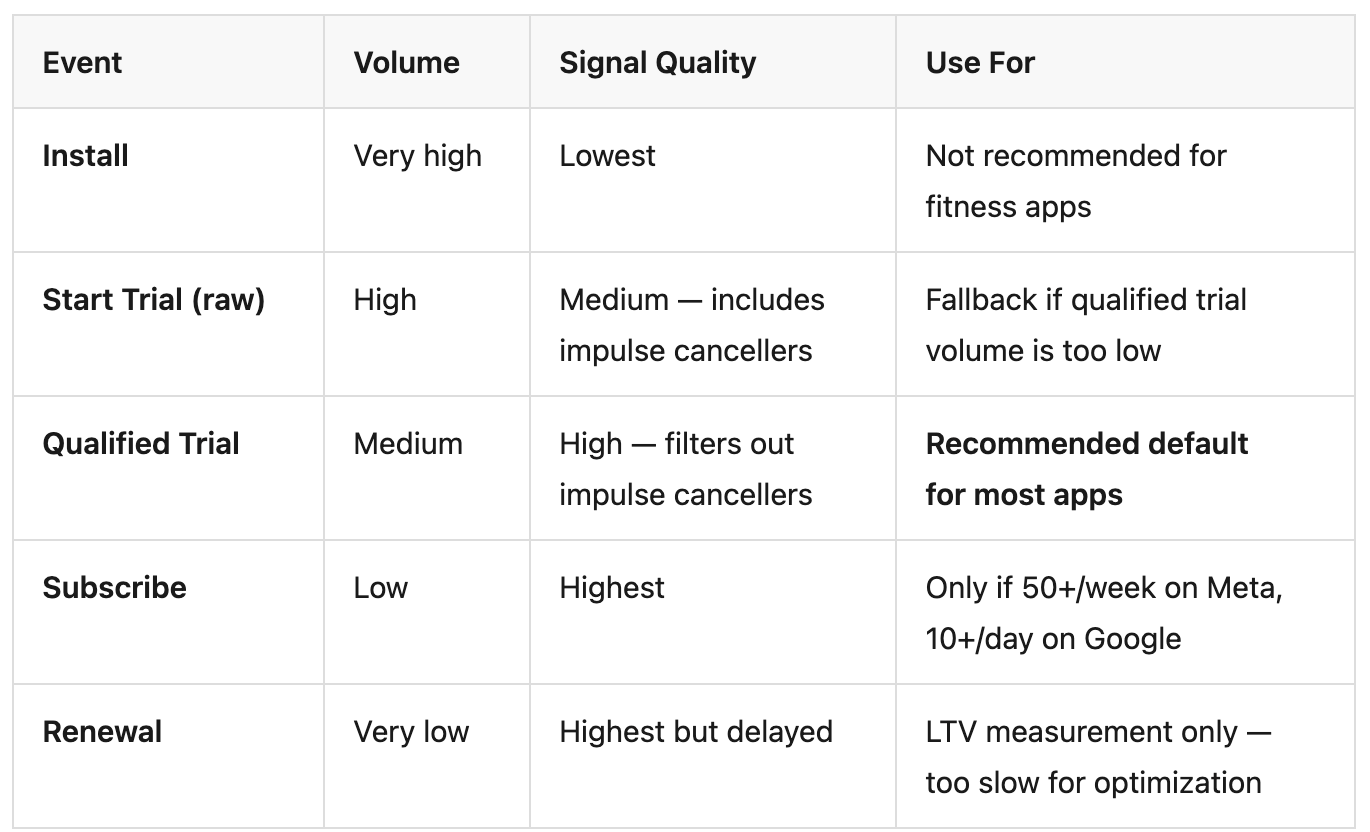
Not every event in the subscription funnel is suitable for optimization. Here is how the conversion event strategy breaks down:
| Event | Volume | Signal Quality | Use For |
|---|---|---|---|
| Install | Very high | Lowest | Not recommended for fitness apps |
| Start Trial (raw) | High | Medium — includes impulse cancellers | Fallback if qualified trial volume is too low |
| Qualified Trial | Medium | High — filters out impulse cancellers | Recommended default for most apps |
| Subscribe | Low | Highest | Only if 50+/week on Meta, 10+/day on Google |
| Renewal | Very low | Highest but delayed | LTV measurement only — too slow for optimization |
The rule: optimize for the deepest funnel event that still meets the platform's volume threshold.
For a fitness app generating 200 trials/week: Qualified Trial (filtering ~30% impulse cancellers) yields ~140 events/week — enough for 2-3 ad sets on Meta. Subscribe at 70/week only works with 1 ad set. The event choice directly constrains your campaign structure.
A Practical Event Map for Fitness Apps
| Meta | TikTok | ||
|---|---|---|---|
| Start with | Qualified Trial (AEO) | Trial Started (tCPA) | Subscribe (AEO) |
| Graduate to | VO with subscription value | tROAS with Firebase revenue | VBO (Android only) |
| Volume threshold | 50/ad set/week | ~10/day/campaign | 50 total or 7 days |
| Budget guidance | 50x target conversion cost | 10x target CPA | Let learning phase complete |
| Max bid change during learning | Avoid significant changes | Max 20% | Max 10% |
| When to move up | 30+ purchases/week, 5+ distinct values | Sufficient revenue data in Firebase | 30+ purchases with value in 7 days |
Common mistakes to avoid:
- Same event on all platforms. Meta and Google have different volume requirements and optimization mechanics. What works on Meta may starve Google of data, or vice versa.
- Raw trials instead of qualified trials. Impulse cancellers contaminate the signal. A 2-4 hour delay filters them out before the event reaches the ad platform.
- Optimizing for Install when you have trial volume. If you generate 50+ trials per ad set per week, there is no reason to optimize for Install. You are leaving signal quality on the table.
How to Validate Your Event Strategy With Channel-Level Data
Changing your optimization event is a hypothesis. If you switch from Start Trial to Qualified Trial on Meta, you need to know: did CPS improve, or did volume drop too far?
What to Measure After Changing Your Optimization Event
- Conversion rate at each funnel stage by channel — Install → Trial → Subscribe. If trial-to-subscribe improved after switching events, the new signal is working.
- CPS by channel over time — the primary metric. Track weekly for 4-8 weeks after the change.
- Event volume by ad set — verify that the new event meets the platform's learning threshold. If not, consolidate ad sets or move one level up in the event hierarchy.
This requires an attribution system that tracks the full funnel — install to trial to subscription — by channel.
How Airbridge Core Plan Connects Events to Subscription Outcomes
Core Plan tracks Install, Start Trial, and Subscribe as standard events with attribution across Meta, Google, Apple Search Ads, and TikTok. The Actuals Report shows conversion rates at each funnel stage by channel — so you can see whether your event strategy is actually driving subscribers, not just the event you optimized for.
With native RevenueCat and Adapty integration via S2S, subscription events flow into attribution automatically. Before changing your optimization event, this data shows which channels have the widest gap between trials and subscriptions. After the change, it validates whether the new event improved CPS.
Airbridge Core Plan vs Traditional MMP
| Capability | Traditional MMP (Typical) | Airbridge Core Plan |
|---|---|---|
| Install → Trial → Subscribe by channel | Available, but may require premium tier for full funnel | Standard events with full funnel attribution |
| Billing platform integration | Native integrations available (RevenueCat, Adapty supported) | Native RevenueCat/Adapty via S2S |
| Event-level performance by channel | Available with configuration, often behind add-on pricing | Actuals Report with event breakdown |
| Time to first insight | Days (partner credential setup + data accumulation) | Hours (standard events from day one) |
| Setup time | Days to weeks | Hours |
| Pricing model | Annual contract + add-ons | Pay-as-you-go, $0.05/install |
| Free tier | Limited or none | 15K free attributed installs. All features included |
The Conversion Event Is an Instruction — Send the Right One
The event you send to Meta, Google, and TikTok is not a tracking configuration. It is an instruction that tells the algorithm which users to find. Send installs, get installers. Send raw trials, get impulse cancellers. Send qualified trials, get engaged users.
The right event depends on your platform, your volume, and your budget. The only way to validate your choice is to measure the full funnel — install to trial to subscription — by channel.
Ready to transform your mobile growth?
Learn how Airbridge helps leading brands measure and optimize every touchpoint.