Best App Marketing Measurement Tool in 2026 for Startups: Why Airbridge Core Plan Works for Early Growth
Many startups are spending $10,000–$20,000/month on paid acquisition without knowing which channel actually generates paying subscribers.
Installs grow. Trials increase. Campaign dashboards look promising. But without attribution, CAC calculations become unreliable and budget decisions are based on guesswork — not revenue data.
In this guide, we'll explore why proper app marketing measurement matters for startups, why most traditional Mobile Measurement Partners (MMPs) aren't built for early-stage teams, and how Airbridge Core Plan helps startups measure installs, trials, and subscriptions without the complexity of enterprise analytics tools.
Key Takeaways
- App marketing without attribution creates growth blind spots: startups cannot identify which channels actually drive subscriptions and revenue.
- Scaling paid acquisition without measurement leads to wasted budget: startups often increase ad spend before knowing which campaigns produce high-value users.
- Most traditional MMP platforms are designed for enterprise companies: high base pricing, complex integrations, and feature overload make them difficult for early-stage teams.
- Startups need simple attribution focused on subscription conversion: early growth teams primarily need to track the journey from install → trial → subscription.
- Airbridge Core Plan provides a streamlined measurement layer for startups: standard events, pre-integrated channels, and native RevenueCat/Adapty S2S — setup in hours, not weeks. Start with 15K free attributed installs.
Why App Marketing Without Proper Measurement Fails Startups
Many startups begin running paid user acquisition before they install a proper measurement layer. The logic is simple: launch ads, acquire users, and hope conversions follow.
But without accurate attribution, app marketing quickly becomes guesswork.
You might see installs increasing. You might see trial signups rising. But you won't know which channel, campaign, or ad actually drove the subscription revenue.
Why Running Paid UA Without Attribution Leads to Guesswork
Imagine a startup launching an AI writing app. The team begins running ads across Meta Ads, Google Ads, and Apple Search Ads.
Within two weeks, they earn 10,000 installs, 2,000 trials, and 350 subscriptions. On the surface, the campaign looks successful. But without a mobile measurement partner (MMP), the team cannot answer critical growth questions:
- Which channel generated the highest-quality users?
- Which campaign drove actual subscriptions?
- Which ads created high trial drop-off?
Without attribution, the startup cannot optimize spend. Budgets shift based on intuition instead of revenue signals — and this often leads to scaling the wrong channels.
Revenue Leakage: What Happens When Startups Scale Ads Without Measurement
Consider that same AI writing app team, now ready to spend $20,000/month across Meta, Apple Search, and Google Ads.
Without an MMP, they cannot determine which channel performs better. The budget gets split evenly — $6,666 to each channel — regardless of actual performance.
But with attribution in place, the data tells a very different story:
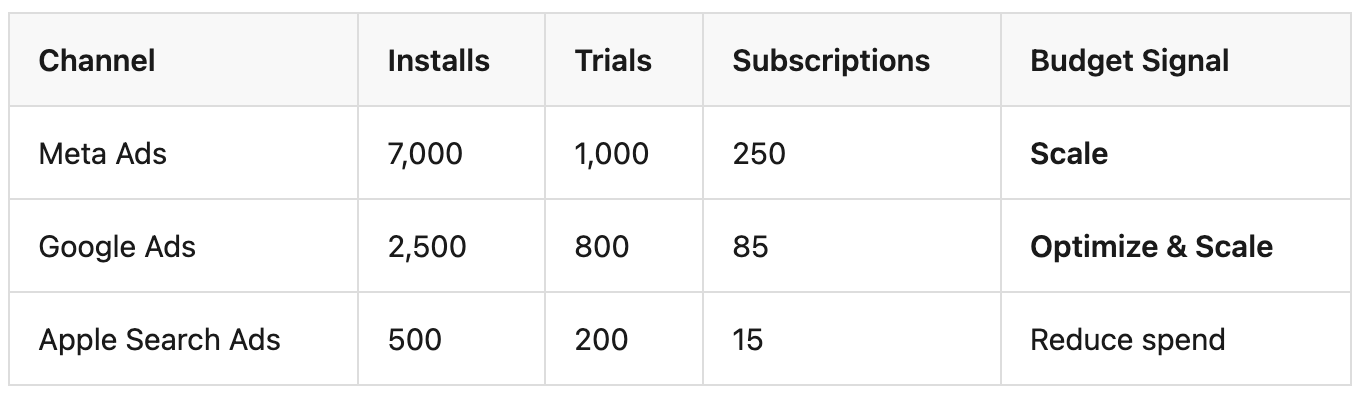
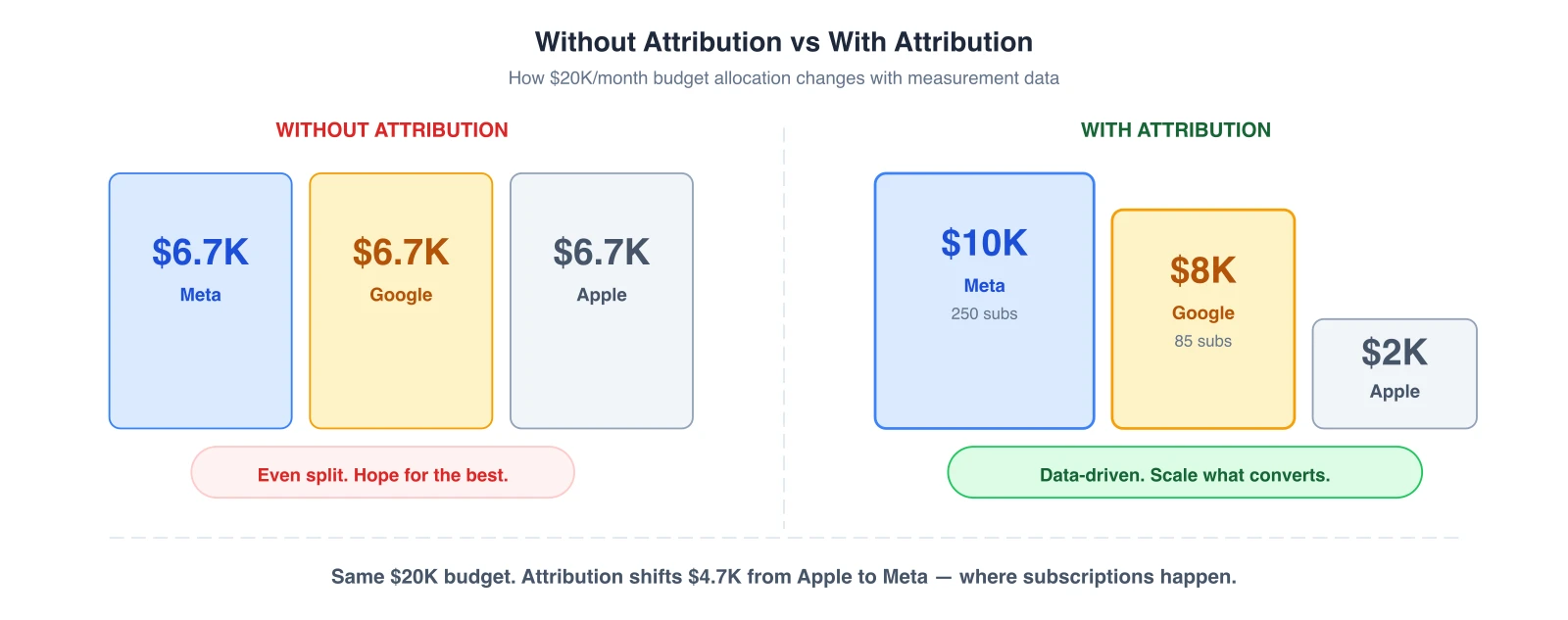
This insight immediately changes the budget growth strategy:
- Scale Meta & Google campaigns — both show strong subscription conversion
- Reduce Apple Search Ads spend — 500 installs, only 15 subscriptions
- Improve Google targeting — strong trial-to-subscription rate
Without measurement, that optimization opportunity remains invisible — and budget keeps flowing to underperforming channels.
The Startup Problem: Traditional MMP Tools Are Built for Enterprise
Once startups realize they need proper attribution, they usually start researching mobile measurement partners. Typical search queries look like this:
- AppsFlyer vs Adjust for startups
- Free MMP for under 10k MAU
- Best app marketing measurement tool
But very quickly, founders run into a frustrating reality. Most attribution platforms were built for mature mobile companies running millions in ad spend — not early-stage teams experimenting with their first user acquisition campaigns.
Why Most Mobile Measurement Platforms Target Large Apps
Traditional MMP platforms are designed to support:
- Global advertising operations across dozens of networks
- Large analytics teams with dedicated data engineers
- Complex event schemas and custom attribution models
- Raw data exports to enterprise data warehouses
These capabilities are powerful — but they introduce a problem for startups. The tools assume you already have dedicated growth teams, data engineers, and large marketing budgets.
For early-stage apps, that assumption rarely holds. Instead of needing enterprise-level analytics, these teams primarily need one clear signal: "Are paid users converting into subscriptions — and which channel is driving that revenue?"
Three Reasons Startups Struggle with Traditional MMPs
When startups try to implement enterprise measurement platforms, they often encounter three growth blockers.
1. High base pricing
Enterprise MMPs like AppsFlyer and Adjust often charge thousands of dollars monthly minimums before usage costs even begin — plus long-term contracts and overage pricing. For a startup spending $5K–$20K on ads, this pricing structure is often unrealistic.
Airbridge Core Plan uses a pay-as-you-go model at $0.05/install — so startups can get full attribution without a large upfront commitment, regardless of current ad spend level.
2. Implementation complexity
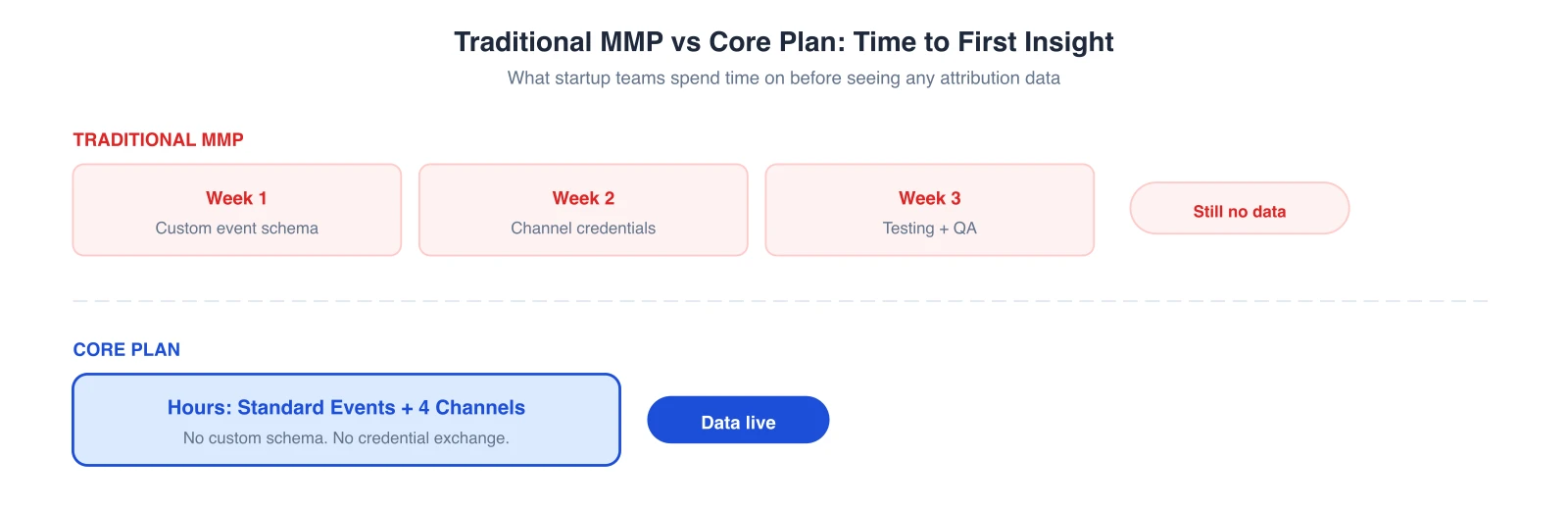
Many MMP platforms require custom event schema design, complex attribution configurations, and advanced analytics setups. For startups without a dedicated analytics engineer, this slows down time-to-value significantly.
What should take hours can take weeks of integration work.
3. Feature overload
Enterprise MMP tools include capabilities that startups rarely need early on:
- Multi-touch attribution (MTA)
- Fraud detection layers
- Raw data warehouse exports
- Dozens of ad network integrations
These features are valuable for mature teams. But for early-stage apps, they create more setup work without improving early growth decisions.
The Startup Attribution Gap
This creates a clear gap in the market. Startups need a measurement solution that is:
- Fast to implement — insights in hours, not weeks
- Focused on subscription conversion — install → trial → subscribe
- Compatible with major ad channels — Meta, Google, Apple, TikTok
- Affordable for early-stage budgets — no $2K+ monthly minimums
- Designed for small growth teams — no data engineer required
Airbridge Core Plan: A Measurement Solution Designed for Startup Growth
Early-stage apps don't need a full enterprise analytics stack. What they need first is a clear signal that connects paid acquisition to subscription revenue.
Airbridge Core Plan was designed around one core question: "Are paid users converting into subscriptions, and which channels are driving value?"
Built specifically for subscription and AI apps running their first paid campaigns, Core Plan gives early-stage teams the visibility they need to understand whether user acquisition is actually generating revenue — without the setup complexity of enterprise tools.
1. Core Measurement Capabilities for Subscription Apps
Core Plan provides the essential measurement layer needed to track the subscription funnel.
Attribution & Tracking
- Paid UA attribution across major channels
- Install tracking
- Subscription conversion attribution
- Attribution rules configuration
Event Tracking
Core Plan supports 30+ standard app events, including the key subscription lifecycle signals your team needs most:
- Install
- Sign-up
- Start Trial — Where ad platforms often claim credit
- Subscribe — What actually drives MRR
- Unsubscribe
- Order Complete
These standard events allow startups to track the entire subscription funnel without designing custom event schemas — one of the biggest time sinks when implementing enterprise MMPs.
2. Native RevenueCat and Adapty Integration
Most subscription apps already use RevenueCat or Adapty for billing. Core Plan connects to both via server-to-server integration — subscription events (trial start, subscribe, renewal, cancellation) flow into attribution automatically. No custom event mapping required.
3. Built-In Reporting for Early-Stage Growth Teams
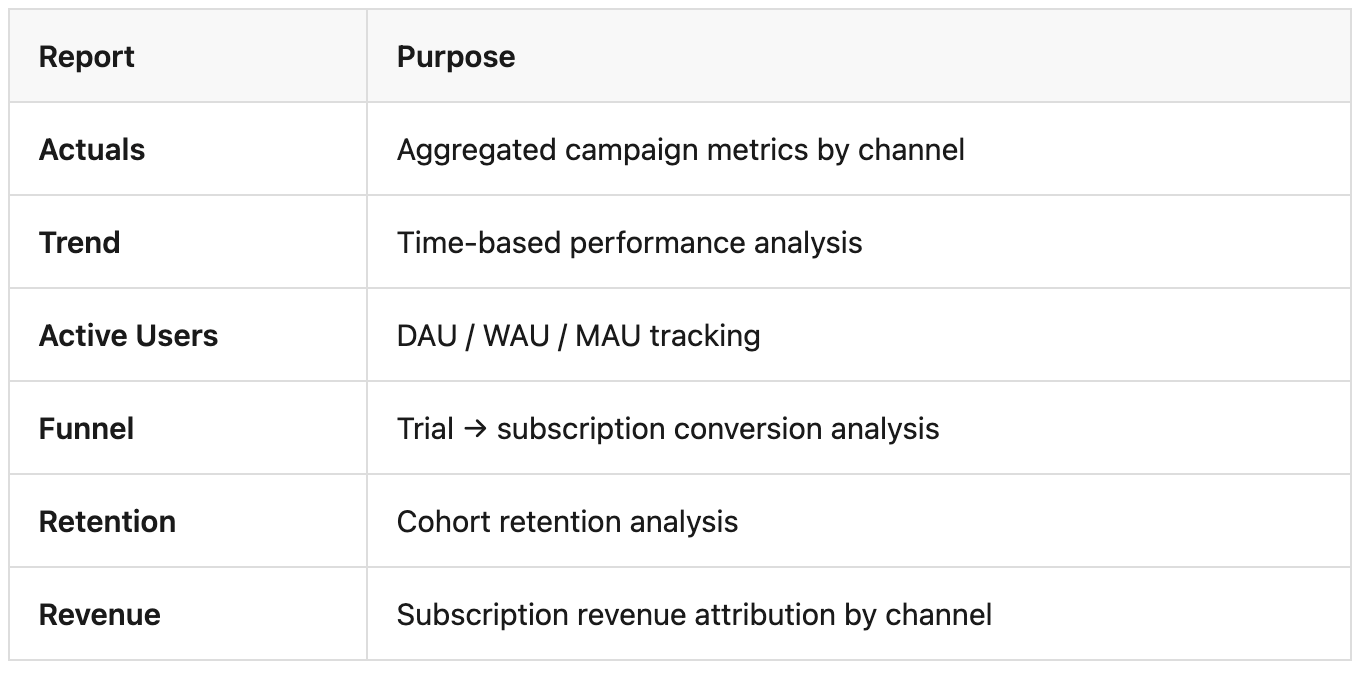
Core Plan includes six built-in analytics reports designed for early growth monitoring:
4. Coverage Across the Major Ad Channels
Most startups concentrate their early marketing budget on a small set of ad platforms. Core Plan supports the four major self-attributing networks (SANs) that represent 80–90% of early-stage paid acquisition spend:
- Meta Ads
- Google Ads
- Apple Search Ads
- TikTok For Business
This allows startups to measure their main marketing activities without additional integrations or complex setup.
5. Why a Simplified Feature Set Helps Startups Move Faster
Core Plan intentionally simplifies features that early-stage teams often don't need yet:
- No custom events — 30+ standard events cover the full subscription funnel
- Maximum 2 third-party integrations — e.g., Amplitude + RevenueCat
- No raw data export — not needed until you have a data warehouse
- Major SAN channels only — covering 80–90% of typical startup ad spend
For small teams, this simplified structure reduces setup time from weeks to hours and keeps focus on the core goal: understanding which marketing channels generate subscription revenue.
What to Look for in an App Marketing Measurement Tool
Not all MMP tools are built for the same stage of growth. The right tool for an enterprise company running millions in ad spend is rarely the right tool for an early-stage startup.
When evaluating attribution platforms, these are the criteria that matter most for early-stage subscription apps:
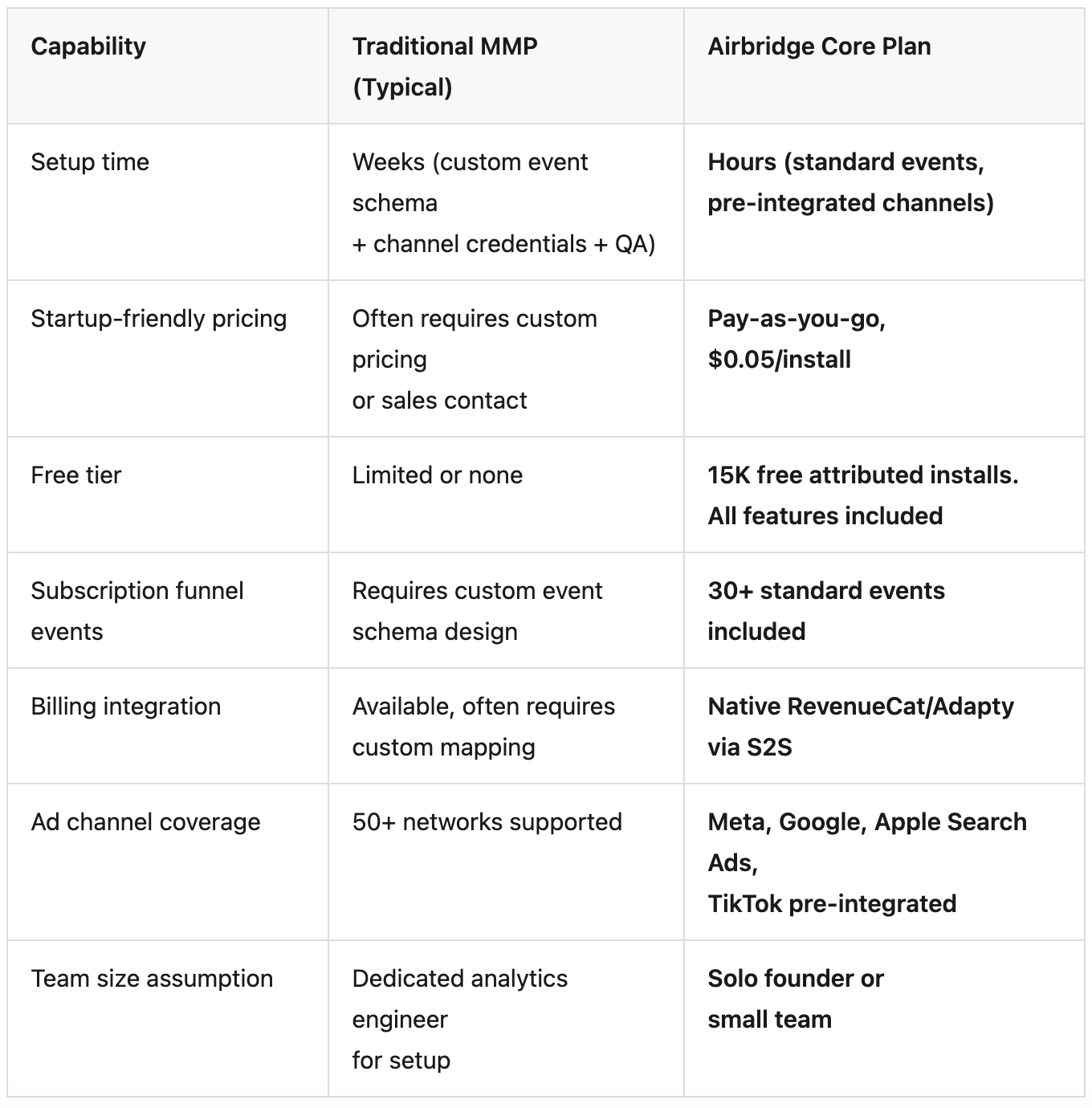
Enterprise MMPs are powerful platforms — but they're optimized for teams that already have data engineers, large budgets, and complex analytics needs. Core Plan is built for the stage before that: when a startup needs reliable attribution fast, without the overhead.
FAQ: App Marketing Measurement and MMP Tools for Startups
1. When should a startup upgrade from Core Plan to a full MMP?
Startups typically upgrade when their growth operations become more complex. This usually happens when teams need:
- Custom event tracking beyond standard subscription events
- Multiple ad network integrations beyond GMAT
- Raw data exports to data warehouses (e.g., AWS S3, BigQuery)
- Advanced attribution models (MTA, fraud detection)
- Agency or media partner access
At that stage, a full-scale MMP like Airbridge's Growth Plan provides the deeper analytics infrastructure needed to support larger-scale marketing operations.
2. How quickly can startups start seeing attribution insights with Core Plan?
Once events such as installs, trials, and subscriptions begin flowing into the measurement system, marketers can start analyzing channel performance. Core Plan is designed for fast time-to-value — setup typically takes hours, not days.
After tracking is configured and ads are running, teams can answer:
- Which campaigns drive installs
- Which channels produce trials
- Which users actually convert into paying subscribers
Start Measuring What Actually Drives Subscription Revenue
If you're launching paid user acquisition for a subscription app, Airbridge Core Plan was built for your stage. Get attribution set up in hours, connect installs to subscription revenue, and stop scaling channels based on guesswork.