Influencer Marketing Cuts CAC — But Only If You Can Measure It

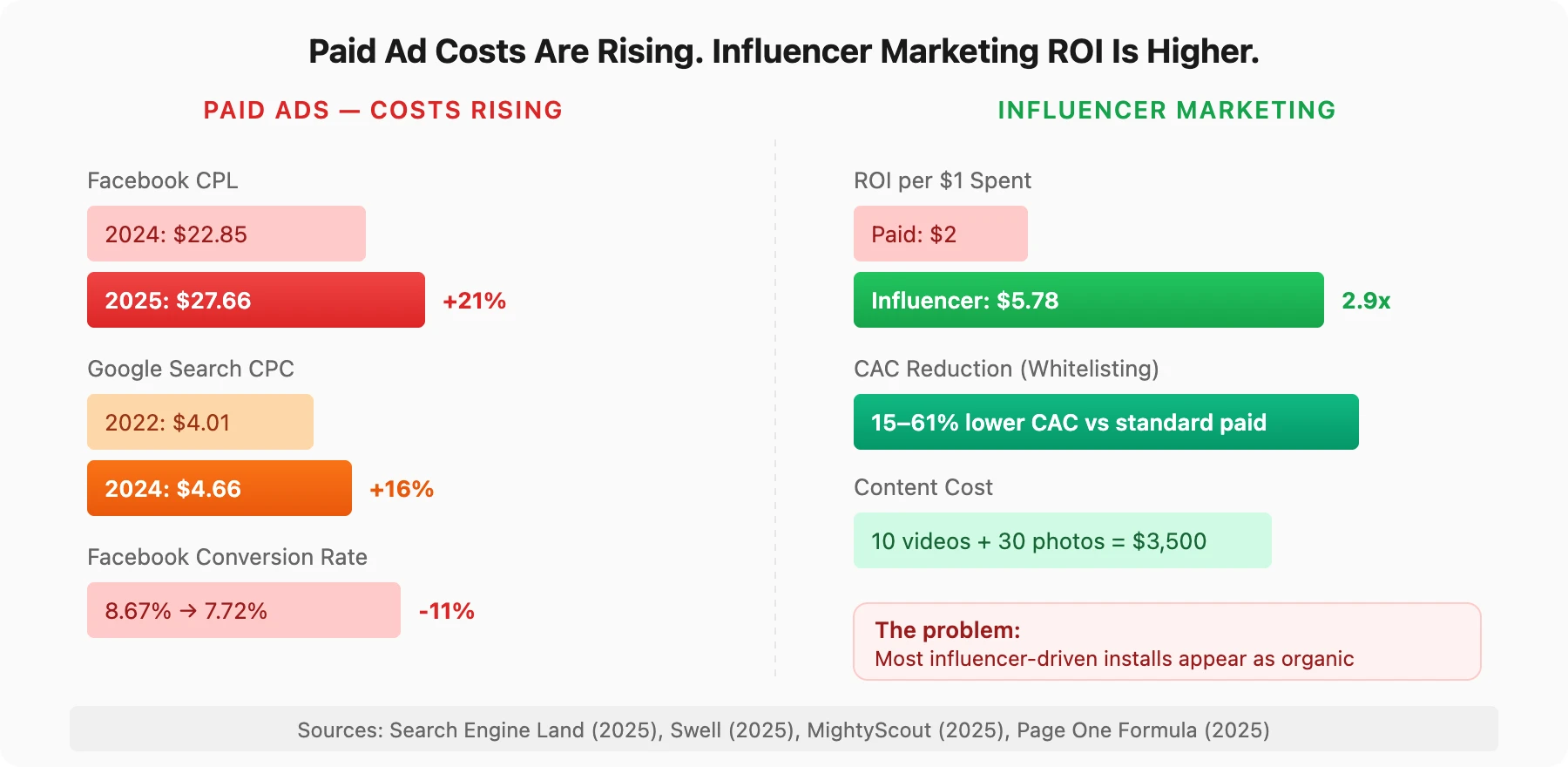
Your Facebook cost per lead jumped 21% this year to $27.66. Google search CPC hit $4.66 — up from $4.22 last year and $4.01 the year before. You are spending more to acquire users who are not subscribing at a higher rate.
Meanwhile, a fitness influencer posts a 60-second workout video mentioning your app. Comments fill with "what app is this?" The App Store ranking ticks up. New installs appear — but in your dashboard, they show up as organic. You cannot tell which influencer drove them, whether those users started trials, or if any of them became paying subscribers.
This is the influencer marketing attribution gap. The channel that returns $5.78 for every $1 spent — nearly 3x paid media's ~$2 return — is the one most teams cannot measure.
Key Takeaways
- Paid ad costs are rising faster than conversion rates. Facebook CPL up 21%, Google CPC up 16% in two years. More spend, not more subscribers.
- Influencer marketing produces higher ROI — but only in aggregate. ROI of $5.78 per $1 and CAC reductions of 15–61% are proven. The problem is attributing those results to specific influencers and campaigns.
- Most influencer-driven installs appear as organic. Users see a video, search the App Store directly, and install — without clicking a trackable link. No click, no attribution.
- Without attribution, you cannot connect influencer spend to subscription revenue — making it impossible to compare influencer CAC to paid CAC on an equal basis.
- Measuring influencer marketing for fitness apps requires deep links, an MMP, and billing integration — not just UTM parameters or coupon codes.
Paid Ad Costs Are Rising — Conversions Are Not
The cost of acquiring users through paid channels is increasing across every major platform.
- Facebook: Average cost per lead reached $27.66 in 2025 — up 21% year-over-year. Conversion rates dropped from 8.67% to 7.72%. You are paying more per lead while fewer leads convert.
- Google: Average search CPC hit $4.66 in 2024, up from $4.01 in 2022. Some sectors saw 25%+ annual increases. The long-term trend is consistent: CPC grows faster than inflation.
For fitness and health apps, this creates a specific problem. Your subscription payback window depends on keeping CAC below a threshold — and that threshold is not moving up as fast as ad costs. When CPL rises this fast but your subscription price stays at $9.99/month, every dollar of CAC inflation compresses your margin.
This is why teams are shifting budget toward influencer marketing.
Why Influencer Marketing Works for Fitness Apps
The numbers support the shift:
- ROI: Influencer campaigns return nearly 3x what traditional paid media generates per dollar spent.
- CAC reduction: Brands using influencer-based ads with whitelisting have achieved 15–61% lower CAC compared to standard paid campaigns.
- Content efficiency: One fitness brand obtained 10 videos and 30 photos for $3,500 — budget previously allocated to a single professional production.
- Trust transfer: 85% of marketers report that influencer marketing improves customer acquisition quality. For fitness apps, a trainer demonstrating your workout feature carries more credibility than a performance ad.
Fitness apps have a natural advantage here. The product is visual — workouts, transformations, progress tracking — and the audience already follows fitness creators. The channel-audience fit is stronger than almost any other app category.
But there is a gap between "influencer marketing works" and "we know which influencer drives subscribers."
The Attribution Blind Spot
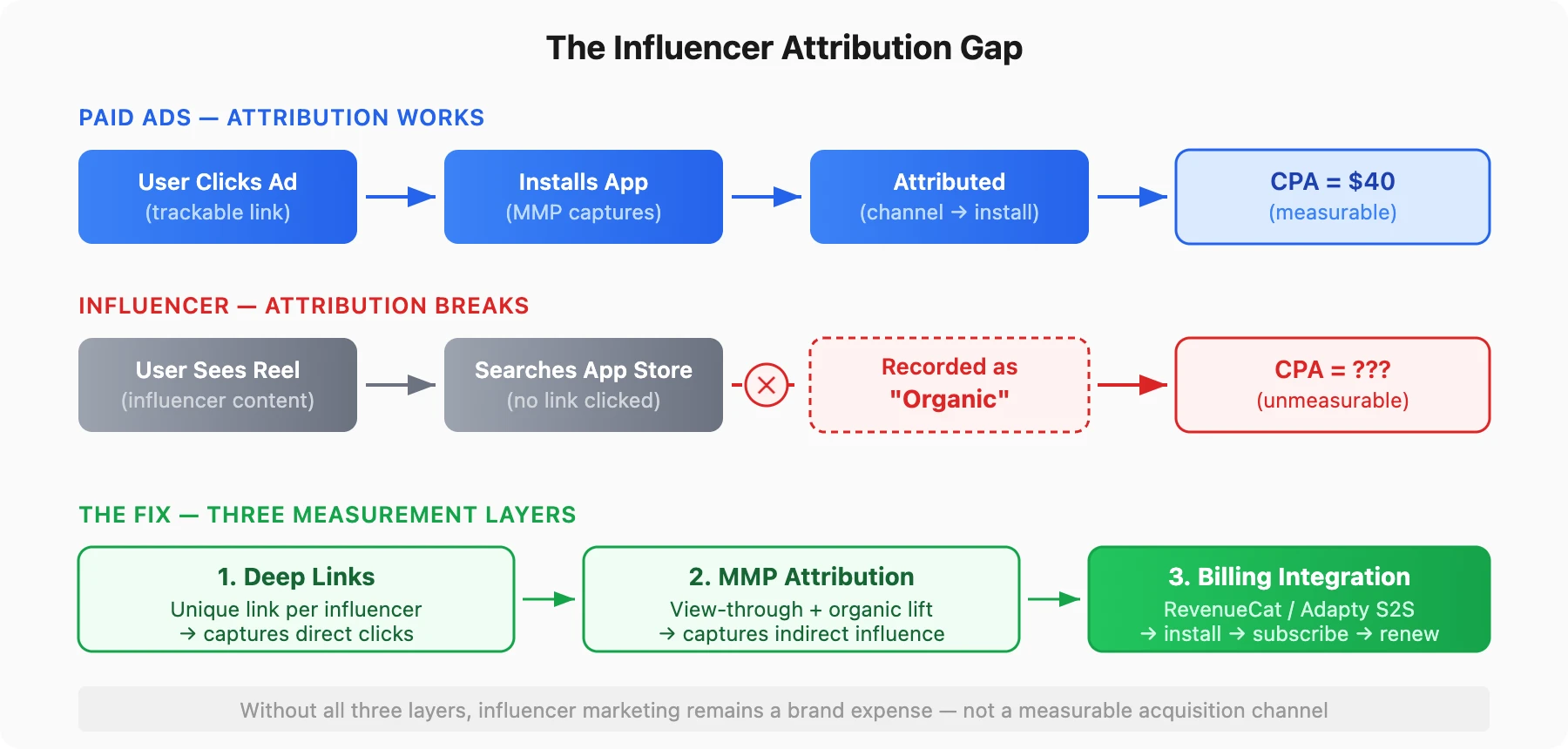
Paid ads have a clear attribution path: user clicks ad → installs app → MMP attributes the install to the campaign. Influencer marketing does not follow this path.
Here is what actually happens:
- User watches an influencer's Instagram Reel mentioning your app
- User does not click the link in bio — instead searches "FitApp" directly in the App Store
- User installs the app
- MMP records this as an organic install
The influencer drove the install. Your attribution system does not know it. The install is real. The influence is real. But the data connection is missing.
This is not a tracking bug — it is a structural problem. Influencer marketing operates through awareness and trust, not through clicks. And most attribution systems are built entirely around clicks.
The result:
- Influencer-driven installs are hidden inside your organic numbers. You see organic installs spike after a campaign, but you cannot isolate which influencer caused it.
- Install-level data is not enough. Even when an influencer uses a trackable link and you capture the install, you still cannot see if that user started a trial, subscribed, or renewed — because billing events live in a different system.
- Coupon codes only capture a fraction. Users forget codes, skip them, or subscribe after the code expires. Coupon-based attribution captures maybe 20–30% of actual influencer-driven conversions.
- You cannot tell which influencers produce subscribers vs installers. An influencer with 500K followers may drive 2,000 installs and 10 subscribers. A micro-influencer with 30K followers may drive 200 installs and 50 subscribers. Without subscription-level attribution, both look the same in your budget review.
How to Measure Influencer Marketing for Fitness Apps
Measuring influencer marketing requires connecting three data layers that are usually disconnected: influencer activity, install attribution, and subscription billing.
1. Deep Links Per Influencer
Every influencer needs a unique deep link — not a generic UTM parameter. Deep links route users through the App Store while preserving attribution data. When a user clicks the link and installs, the MMP can attribute that install to the specific influencer, campaign, and content piece.
What this captures: Direct-click installs from influencer content. This is the baseline — users who actually click the link in bio or swipe-up.
What this misses: Users who see the content but search the App Store directly. This is where the next layer matters.
The link should also support deferred deep linking — so a user who installs from a trainer's "30-day ab challenge" link lands on that specific program, not the generic home screen. And if you work with dozens of micro-influencers per campaign, confirm you can generate and manage unique links at scale.
2. MMP Attribution With View-Through and Organic Lift
An MMP extends attribution beyond clicks. View-through attribution can capture users who saw an influencer ad (via whitelisting) but did not click. Organic lift analysis compares organic install rates during and outside campaign periods to estimate influencer-driven organic installs.
What this captures: A broader picture of influencer impact — not just clicks but influence-driven behavior. Look for organic lift analysis that can isolate install spikes during campaign windows — if a trainer posts a workout video on Monday and your installs spike Tuesday through Thursday, you need a way to quantify that lift, not just see it in a chart.
3. Billing Integration for Subscription Attribution
Install attribution alone is not enough. You need to connect billing events — trial start, subscribe, renew, cancel — to the attributed install source. This requires a server-to-server integration between your billing platform (RevenueCat, Adapty) and your MMP.
What this captures: Which influencer's installs actually converted to subscribers, and whether those subscribers renewed or churned. This is the layer that turns influencer marketing from a brand expense into a measurable acquisition channel. The integration should distinguish subscription tiers — monthly ($9.99) vs annual ($59.99) — by attributed source. An influencer whose users pick annual plans is worth far more than one who drives monthly trials that churn after 30 days.
Without all three layers, you have partial data. Deep links without billing integration tell you which influencer drove installs — but not revenue. Billing data without attribution tells you subscription trends — but not which influencer caused them.
When these three layers work together, the measurement stack also needs to support unified reporting — influencer and paid campaign data in the same dashboard, not separate tools — and predefined subscription events so you are not designing custom event schemas for every campaign.
Questions Your Measurement Stack Should Answer
If you are running or planning influencer campaigns, test your current setup against these questions:
- Can you tell which influencer drove which subscribers? Not just installs — subscribers. If you can only see "Influencer A drove 500 installs," you are missing the part that matters.
- Can you compare cost-per-subscriber across influencer and paid channels? If Facebook shows CPS of $40 but your influencer data stops at installs, you have no basis for budget allocation.
- Do influencer and paid ad performance appear in the same dashboard? If influencer results live in a spreadsheet while paid performance lives in your MMP, optimization decisions are made on incomplete data.
- Can you track the full journey — from content view to install to trial to renewal? Partial visibility means partial decisions. A user who installs but never subscribes is a different outcome than one who subscribes and renews for 12 months.
- Does your setup scale to dozens of concurrent influencer partnerships? One deep link for one influencer is easy. Managing unique links, attribution windows, and billing data across 30 micro-influencers per campaign is where most stacks break.
If your current stack cannot answer all five, the three-layer framework above shows where the gaps are.
Influencer Marketing Is Not a Measurement Problem — It Is a Connection Problem
The ROI of influencer marketing for fitness apps is already proven — the data above confirms it. The gap is not whether influencer marketing works — it is whether you can see which part of it works.
As paid acquisition costs continue climbing, the pressure to diversify into influencer marketing only increases. But diversifying without measuring means replacing one blind spot — rising paid CAC — with another: unattributed influencer spend.
The connection between influencer content, app installs, and subscription revenue is technically possible. The question is whether your current measurement stack closes that gap.
准备好革新您的移动增长了吗?
了解 Airbridge 如何帮助领先品牌衡量和优化每个触点。