Tracking Free Trial to Paid Conversion for Maximizing Subscription LTV

You're spending $5.00 per install. Trials look healthy. But 30 days later – MRR is flat.
For subscription and AI-powered apps, the "Install" has become a vanity metric. If you are spending $5.00 to acquire a user who starts a free trial but never converts to a paid tier, your ROAS isn't just low – it's effectively zero.
The challenge for most growth teams isn't a lack of data; it's the attribution blind spot between the ad click and the actual recurring revenue event. When your acquisition data lives in one silo and your App Store revenue lives in another, scaling decisions lack a reliable foundation.
To build a sustainable growth engine, you need to bridge this gap by tracking the entire lifecycle from initial touchpoint to Lifetime Value (LTV).
Key Takeaways
- Installs and free trials don't equal revenue. For subscription and AI apps, the only metric that validates acquisition performance is the free trial → paid subscription conversion.
- The "Freebie Hunter" problem can distort marketing performance. High install and trial volumes may hide campaigns that generate users who never convert into paying subscribers.
- CAC is immediate, but LTV is delayed. Without proper LTV tracking, marketers are forced to scale campaigns based on incomplete signals like installs or trial starts.
- Subscription data often lives in silos. When App Store revenue data is disconnected from attribution data, teams cannot determine which campaigns are actually driving long-term subscribers.
- LTV tracking connects acquisition with real revenue. By linking campaign attribution with subscription lifecycle events such as trial start and subscription, marketers can evaluate channels based on true subscriber value.
- Closing this visibility gap requires an MMP with subscription-specific capabilities — standard events, native billing platform integration, and attribution across major ad channels.
What is Subscription LTV and Why Does Tracking It Matter?
Lifetime Value (LTV) is the total revenue a customer generates throughout their relationship with your app – from the moment they install to their final subscription payment.
For subscription and AI-powered apps, LTV is primarily determined by one critical transition:
Free Trial → Paid Subscriber
Everything before that moment is only a signal of intent. Revenue begins only when a user converts into a paying subscriber.
How to Calculate LTV
There are two common approaches mobile marketers use to calculate LTV:
1) Using CAC
LTV = (ARPU x Average User Lifetime) – CAC
This formula calculates the average revenue a user will generate over the lifetime of their engagement with the app.
2) Using Churn Rate
LTV = ARPU x 1/Churn
Since 1/Churn approximates average customer lifetime, this formula gives you the same result when churn is your primary known variable.
To evaluate acquisition efficiency, use the LTV:CAC ratio separately – a healthy subscription business typically targets 3:1 or higher.
Why LTV Tracking is Your Primary Growth Lever
Consider two acquisition channels:
Channel
Installs
Trials
Paid Subscribers
A
10,000
3,000
120
B
4,000
1,200
320
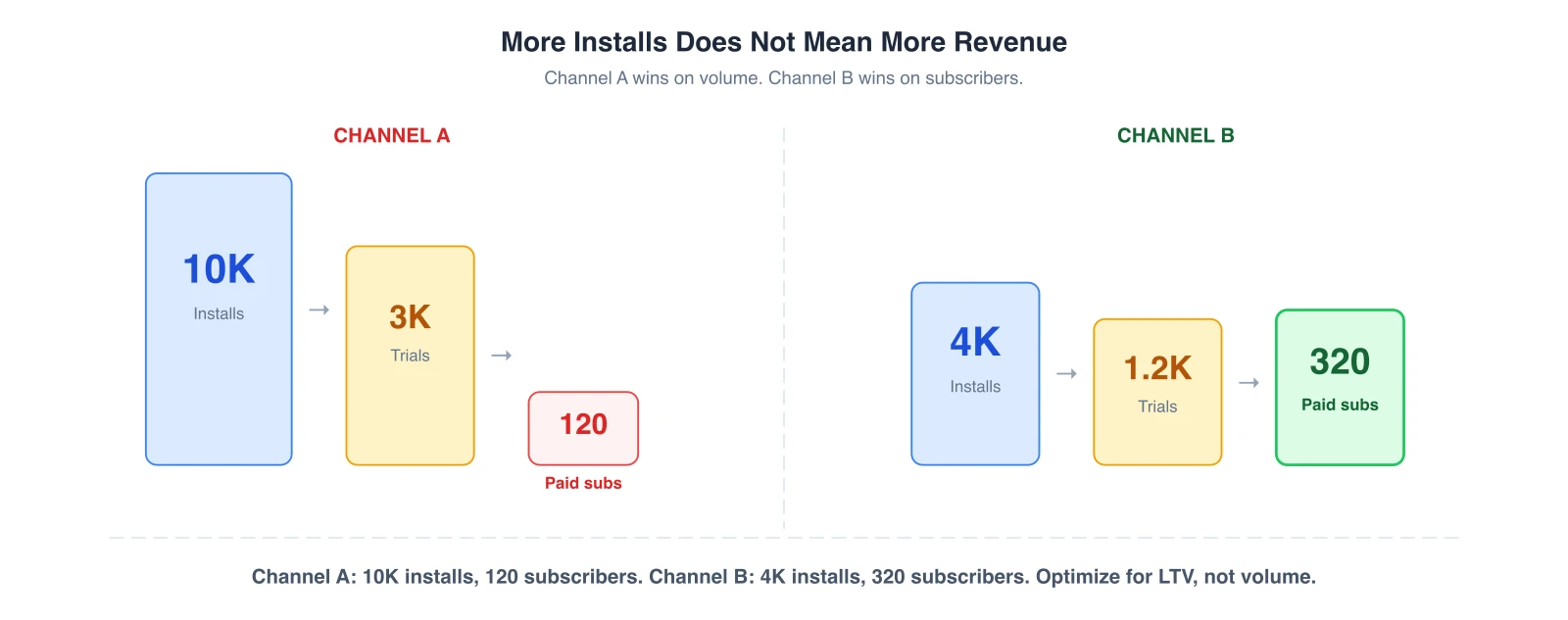
At first glance, Channel A appears stronger because it generates more installs and trials. But Channel B produces almost three times more paying subscribers.
If marketers optimize based only on installs or trial starts, they risk scaling the wrong channel – increasing spend while reducing long-term revenue. In this example, if Channel B's LTV:CAC exceeds 3:1, it may be worth gradually reallocating a portion of Channel A's budget toward Channel B in your next weekly review cycle.
This is why subscription businesses need to measure LTV at the campaign level. Tracking the full conversion path allows teams to answer the question that truly matters: Which acquisition channels generate long-term paying subscribers, not just free trial users?
The "Subscription Silo": Why Many Teams Fail at Scaling
1. The Disconnect Between App Stores and Attribution
The fundamental problem lies in the "Black Box" of Apple and Google's payment ecosystems. When a user clicks an ad, installs your app, and eventually starts a trial, the App Store processes that transaction.
However, the App Store does not natively tell your attribution provider which specific ad creative or keyword led to that dollar.
Without a unified bridge, you face a technical gap:
- The Attribution Gap: You see 100 installs from "Campaign A."
- The Revenue Gap: You see $500 in new subscriptions in your developer console.
- The Scaling Blind Spot: You cannot confirm whether that $500 came from "Campaign A" or organic search.
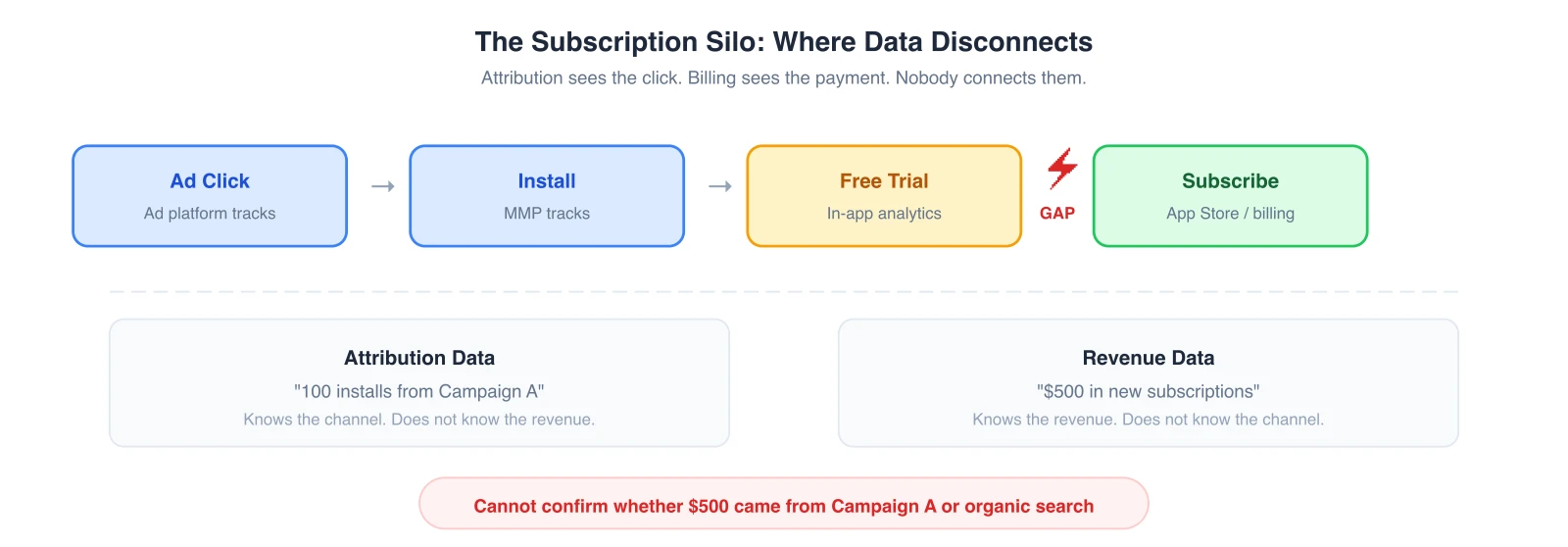
This disconnect often leads teams to rely on "blended ROAS" – a metric that can obscure channel-level inefficiency and make it harder to identify which campaigns are truly driving subscriber growth.
2. The Cost of the "Freebie Hunter" Problem
In competitive markets, optimizing campaigns solely for top-of-funnel volume can lead algorithms toward the lowest-cost users. Often, these turn out to be "Freebie Hunters" – users who engage with free trials but show low intent to convert to paid subscriptions.
The Revenue Leak Scenario: Consider a subscription app that splits $10,000 across two channels:
- Channel A: 1,000 Installs → 200 Trials → 5 Paid Subs (High Churn)
- Channel B: 200 Installs → 50 Trials → 25 Paid Subs (High LTV)
Without trial-to-paid attribution, it's easy to over-invest in Channel A based on install volume alone. High install numbers can mask poor conversion quality – and without connecting attribution to the paid conversion event, budget may be directed toward users unlikely to generate meaningful MRR.
CAC vs LTV – The Metric Gap That Blocks Growth
For subscription-based apps, the "Metric Gap" is a common growth challenge. This gap exists because your outgoing cash (CAC) is a real-time certainty, while your incoming value (LTV) is a delayed probability.
1. Real-Time Costs vs. Delayed Value
Customer Acquisition Cost (CAC) is visible the moment an ad is served. You know exactly what you paid for the click and the install. However, the true Lifetime Value of that user may not materialize for 7, 14, or even 30 days – depending on your trial length and renewal cycle.
For growth teams, this timing gap can create a "Scaling Paralysis":
- The Waiting Cost: Holding off on scaling until 30-day cohort data is available means delaying decisions that could accelerate growth.
- The Scaling Risk: Scaling aggressively based only on "Trial Starts" may direct budget toward users who cancel before the first billing cycle.
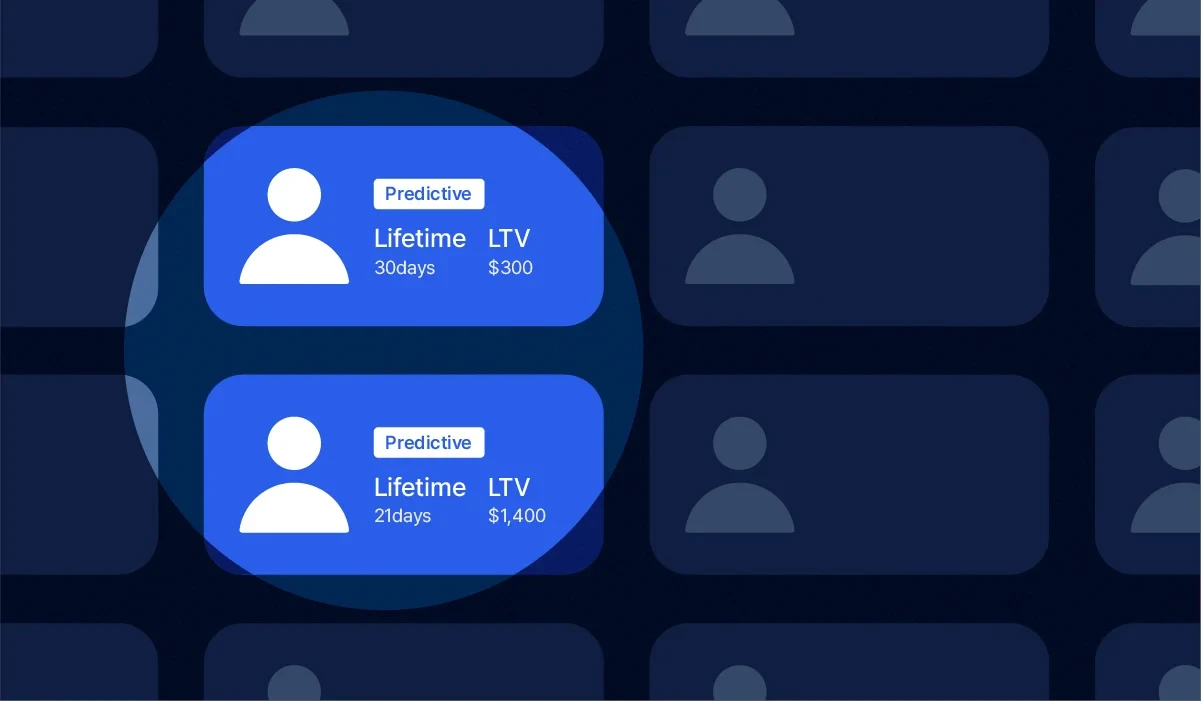
To navigate this, teams benefit from predictive signals – moving beyond tracking "what happened" toward understanding "what is likely to happen" by connecting early-funnel behavior to down-funnel revenue.
2. Moving Beyond "Standard" Install Tracking
For many mobile apps, installs are a reasonable success metric. But for subscription-based products, installs are only the first step in a longer revenue journey. A user who installs your app but never subscribes contributes zero lifetime value.
This is why subscription growth teams need to track the entire monetization funnel, not just acquisition. Once this connection is established, teams can answer the question that determines sustainable scaling: Which ad channels actually produce long-term subscriber LTV?
Aspect
Customer Acquisition Cost (CAC)
Lifetime Value (LTV)
Definition
Total cost to acquire one new customer
Total revenue expected from one customer over time
Calculation
Total acquisition costs ÷ Number of new customers
ARPU × Average Customer Lifetime OR ARPU × (1/Churn Rate)
Time Focus
Immediate cost (upfront investment)
Long-term revenue (future returns)
Primary Use
Budgeting and acquisition efficiency
Retention strategy and growth planning
Optimization Goal
Lower costs while maintaining quality
Extend relationships and increase revenue per customer
Typical Benchmark
Varies by industry; often 20–30% of first-year revenue
Ideally 3x higher than CAC for healthy ROI
Source: Ecommerce CFO
💡 Pro Tip: Weekly Optimization Checklist
- Track "Start Trial" within 7 days post-install (top-funnel gate – early signal of UA quality)
- Measure "Subscribe" conversion rate by channel (true value signal – target 10–20% depending on vertical; below 10% warrants creative or audience review)
- Calculate channel LTV:CAC weekly using 30-day cohorts (target ≥3:1; below 2:1 = hidden MRR leak)
- Monitor Day-30 retention for churn signals (Day-30 retention below 40% signals Freebie Hunter channel)
- Cut channels below 2:1 LTV:CAC ratio; reallocate budget to channels above 3:1
What to Look for in an MMP for Subscription LTV Tracking
When evaluating an MMP for subscription LTV optimization, confirm it supports:
- Full subscription funnel by channel: Install → Trial → Subscribe breakdown by acquisition source — not just installs by channel.
- Native billing platform integration: S2S connection to RevenueCat or Adapty — so subscription events are captured even when the app is not open.
- Predefined subscription events: Standard events for Start Trial, Subscribe, Renew, and Cancel — without requiring custom event schema design.
- Revenue attribution by channel: Subscription revenue tied back to the ad campaign that drove the install, included in standard reporting.
- Cohort retention by acquisition source: Retention curves by the channel that originally acquired the subscriber, not just aggregate retention.
- Usage-based pricing with no annual lock-in: Pay for what you use, not a fixed annual commitment that stays the same regardless of volume.
LTV Tracking Turns Acquisition Into Predictable Revenue
In the subscription and AI app economy, growth is a function of unit economics. Without visibility into the journey from a paid click to a recurring subscription, scaling decisions are based on incomplete data.
By breaking down the "Subscription Silo" and connecting attribution data with real-world revenue events, teams gain the clarity needed to make confident, data-backed decisions.
The right MMP offers a fast path to this visibility – providing essential tools to track standard revenue events, integrate with billing platforms like RevenueCat or Amplitude, and ultimately maximize LTV.
Airbridge Core Plan
Ready to see which channels are actually driving your subscriptions?
Explore the real successful stories here:
Sẵn sàng cách mạng hóa tăng trưởng mobile?
Tìm hiểu cách Airbridge giúp các thương hiệu hàng đầu đo lường và tối ưu mọi điểm chạm.