Decoding Subscription Monetization: Proven Strategies from 100+ Paywall and Pricing Experiments
The subscription app business has always hinged on recurring revenue, yet for many teams the real challenge now is less about securing the initial sign-up and more about what happens after someone downloads the app. Acquisition pipelines are crowded, paid media is costlier, and free trials alone aren’t driving enough conversions. In this landscape, the biggest leverage lies not in getting users in, but in how you engage them, convert them, and keep them paying over time.
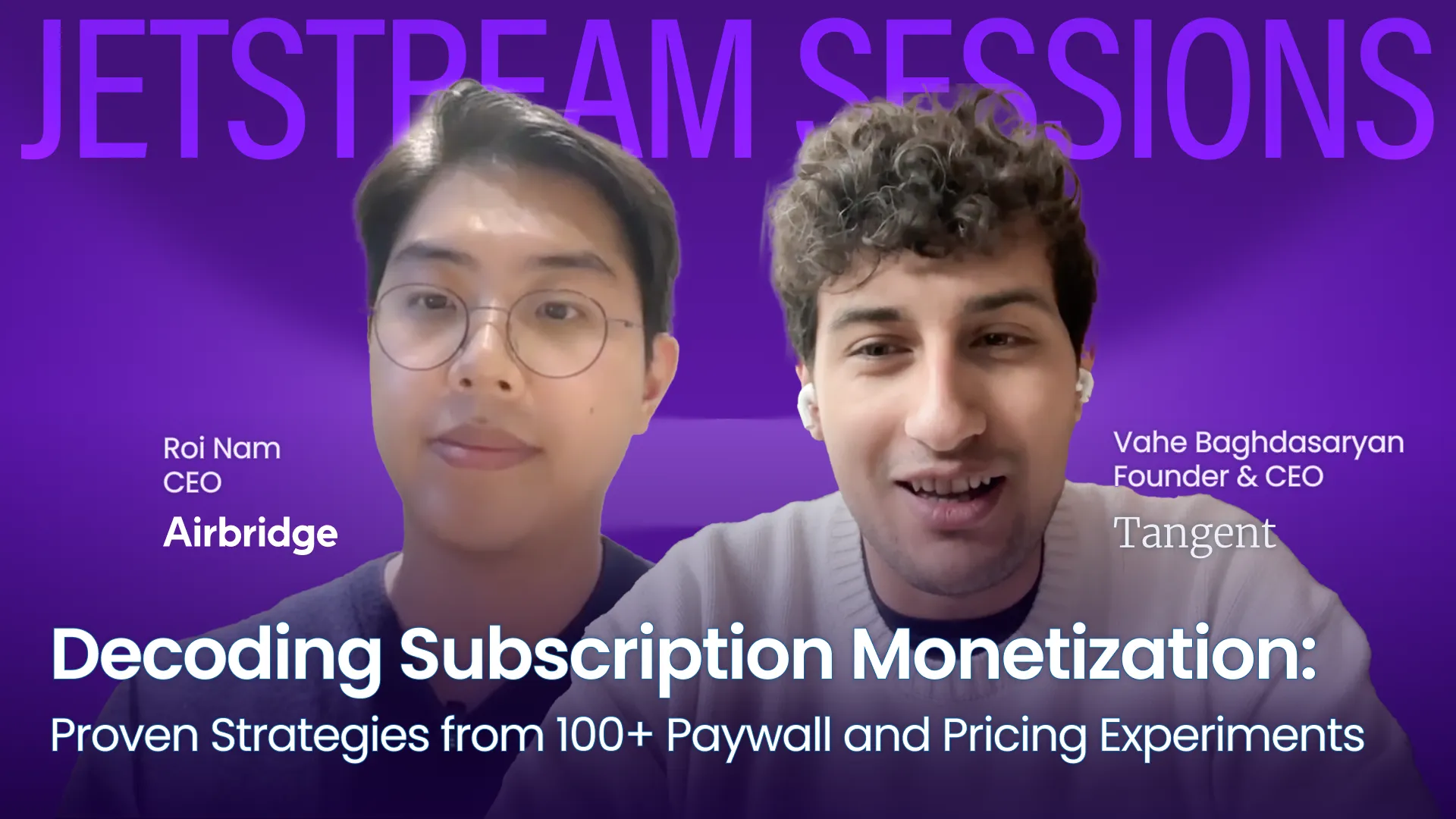
In this latest Jetstream Session, Airbridge CEO Roi Nam spoke with Vahe Baghdasaryan, Founder of Tangent (formerly Paywalls.Design), whose team has helped around 100 subscription apps of all sizes optimize their monetization models within just a year of its launch. Their focus: not quick wins, but sustainable revenue systems built on data, user behavior, and strategic experimentation.
In unveiling his findings, Vahe shows that successful subscription monetization does not rest on a clever price point or a slick screen. It lies in a philosophy. One where every step in the user journey from onboarding to trial to paid to renewal is designed, measured, and iterated.
🎥 Watch the full interview video
The Philosophy Behind Sustainable Monetization
Many teams still tend to treat revenue like a design project — a single paywall to tweak or a pricing table to test. However, Vahe believes that real results come from viewing monetization as a connected system.
A paywall is only one piece of that system. Pricing strategy, offer placement, and lifecycle marketing all influence how users perceive value and decide to subscribe. When these elements are tested in isolation, the impact often fades quickly. When they are connected and informed by shared data, each experiment strengthens the next, creating measurable and repeatable results.
This mindset reframes monetization from a one-off optimization task to a continuous process of learning, testing, and iteration — the same discipline that drives successful product development.
Paywall Optimization: The First Step to Increasing Subscription Conversions
When it comes to subscription monetization, where should app teams begin? For Vahe it depends on a few fundamentals: the app’s size, its current revenue, and how broken the existing paywall is.
“You need to understand your numbers before touching anything else — your conversion rate, ARPU, trial-to-paid ratio — the full picture.”
— Vahe Baghdasaryan, Founder of Tangent.
In most cases, teams begin by testing and optimizing their paywall. This first stage often focuses on improving the onboarding paywall and other in-app paywall placements. Once those foundations are performing well, new opportunities emerge, such as adding paywalls after transaction abandonment, on the home screen, or as win-back prompts for users who cancel their trial.

Vahe Baghdasaryan, Founder of Tangent.
Multi-page Paywalls: Why pairing them with the right offer delivers stronger results
Among recent optimization patterns, one that’s proven especially effective is the multi-page paywall. Instead of hitting users with one paywall that says everything on a single screen, this format spreads the experience across a few lightweight steps helping users understand value before facing cost.
A common multi-page paywall looks like this:
- Welcome screen: A welcome page invites users to “try the app for free”, often paired with a short demo video that highlights key benefits.
- Reassurance screen: The next screen builds trust with a simple message such as “We’ll remind you two days before your trial ends.”
- Progress or benefit screen: A follow-up screen may show progress or reinforce value before moving users to the final paywall.
- Final paywall: The final screen presents the subscription options, typically annual and monthly plans.
However, Vahe emphasizes that it becomes far more effective when coupled with the right offer. One proven example is the paid-trial annual plan. Instead of offering both monthly and annual subscriptions with a free trial, the app presents two annual options: one with a standard free trial and another where users pay a small amount, such as $1.99, for the first month before the full annual billing begins. This paid-trial option often comes with a slight annual discount, making the commitment feel even more compelling.
This simple change reframes the trial as a low-risk commitment rather than a free giveaway. Users who pay even a small fee tend to be more engaged and less likely to churn after the trial.
“A well-built multi-page paywall can deliver around 10% uplift in conversion, but when paired with a compelling offer, that lift can rise to 15–20%. It’s not about changing layouts or using tricks. It’s about finding the right packaging for your premium product with an offer that truly fits the user.”
— Vahe Baghdasaryan, Founder of Tangent.
Running pricing experiments without channel-level data? You need to know if a pricing change lifts ARPU on Meta traffic but drops it on Google — before you roll out globally.**
See Install → Trial → Subscribe by channel. Start with 15K free attributed installs →**
Pricing Optimization: Avoiding the Biggest Pitfalls
Pricing can be one of the most powerful levers for subscription growth, yet it’s also the easiest to get wrong. Vahe cautions that pricing isn’t something to test halfway. Either run the test the right way, or don’t do it at all.
Subscription Pricing Tests Require Patience (Looking Beyond D7, D30 Metrics)
Many teams rush to test price changes expecting quick results, but short-term data rarely tells the full story. Vahe cautions that the biggest mistake teams make is drawing conclusions too early. Many apps decide on new pricing after just a week or two of testing, basing the decision on D7 or D30 ARPU. But these short windows rarely correlate with lifetime value.
“With paywall or placement tests, even if you make a wrong call, you can notice it quickly and revert. But with pricing, it’s super dangerous. You don’t know your refund rate, your renewal rate, or even disputes if you stop the pricing test after a week. It’s so complicated that without enough time, you’ll never know how it truly affects your business.”
— Vahe Baghdasaryan, Founder of Tangent.
If you’re concerned about the long testing cycle, Vahe suggests a practical workaround: take 20% of your traffic, run the price experiment on that segment, and let it sit untouched for about three months. The remaining 80% of users can continue through other ongoing experiments.
Localized Pricing Isn’t Always a Shortcut
Localized pricing is usually an effective strategy for subscription apps expanding into diverse markets. However, a common oversight among many teams is failing to consider how pricing changes actually affect conversion behavior. When prices drop, conversion rates need to rise enough to offset the discount, otherwise, total revenue may decrease.
To minimize risk, teams should always run A/B tests and analyze how ARPU changes before adjusting prices across markets.
Upsell Techniques: Building Revenue Ladders That Go Beyond “Annual”
Upsells can be considered one of the most underrated monetization techniques in the subscription world. Vahe notes that fewer than 10% of top apps on the App Store actively use upsell strategies, leaving a major source of incremental revenue untapped.
Many teams still view the annual plan as the finish line, but lifetime packages or family plans can certainly work as next steps up in the revenue ladder.
“One of the most interesting strategies we started to test recently is offering a lifetime purchase upgrade right after users make the first purchase. We showed them another offer: ‘If you want, you can upgrade to lifetime. Just pay another $50 and you’ll have the product forever’. Surprisingly, around 10% of users took the offer.”
— Vahe Baghdasaryan, Founder of Tangent.
Beyond these simple upgrades, apps can move toward more advanced upsells by launching new features or complementary products for their existing base. These offers tend to perform particularly well among older demographics, who typically have higher purchasing power and are more willing to invest in extending the experience. And once that foundation is built, the opportunities for one-time purchases become nearly endless.
The key to building effective upsell packages is to understand user insights and not be afraid to test new offers. Sometimes, upselling can be as simple as asking users whether they would like to upgrade. For teams already using tools such as Superwall, RevenueCat, or other paywall builders, these tests can be set up and launched within a few hours, provided that product IDs are already configured in the App Store or Play Store.

Roi Nam, Co-founder & CEO of Airbridge and
Vahe Baghdasaryan, Founder of Tangent.
Turning Experiments into Scalable Growth
Subscription monetization isn’t about finding a perfect paywall layout or a magic price point. It’s about building a connected system where every experiment from onboarding flow to offer design, pricing, and upsell — feeds the next through disciplined measurement and iteration. The teams that win are those who test, learn, and optimize with structure, not chance.
That’s where Airbridge helps subscription apps turn monetization experiments into a repeatable, scalable system.
Airbridge Core Plan
Subscribe to success with Airbridge
Vahe's core message is clear: monetization is a system, not a single paywall test. But a system only works when each experiment is connected to the data that tells you what changed — and where.
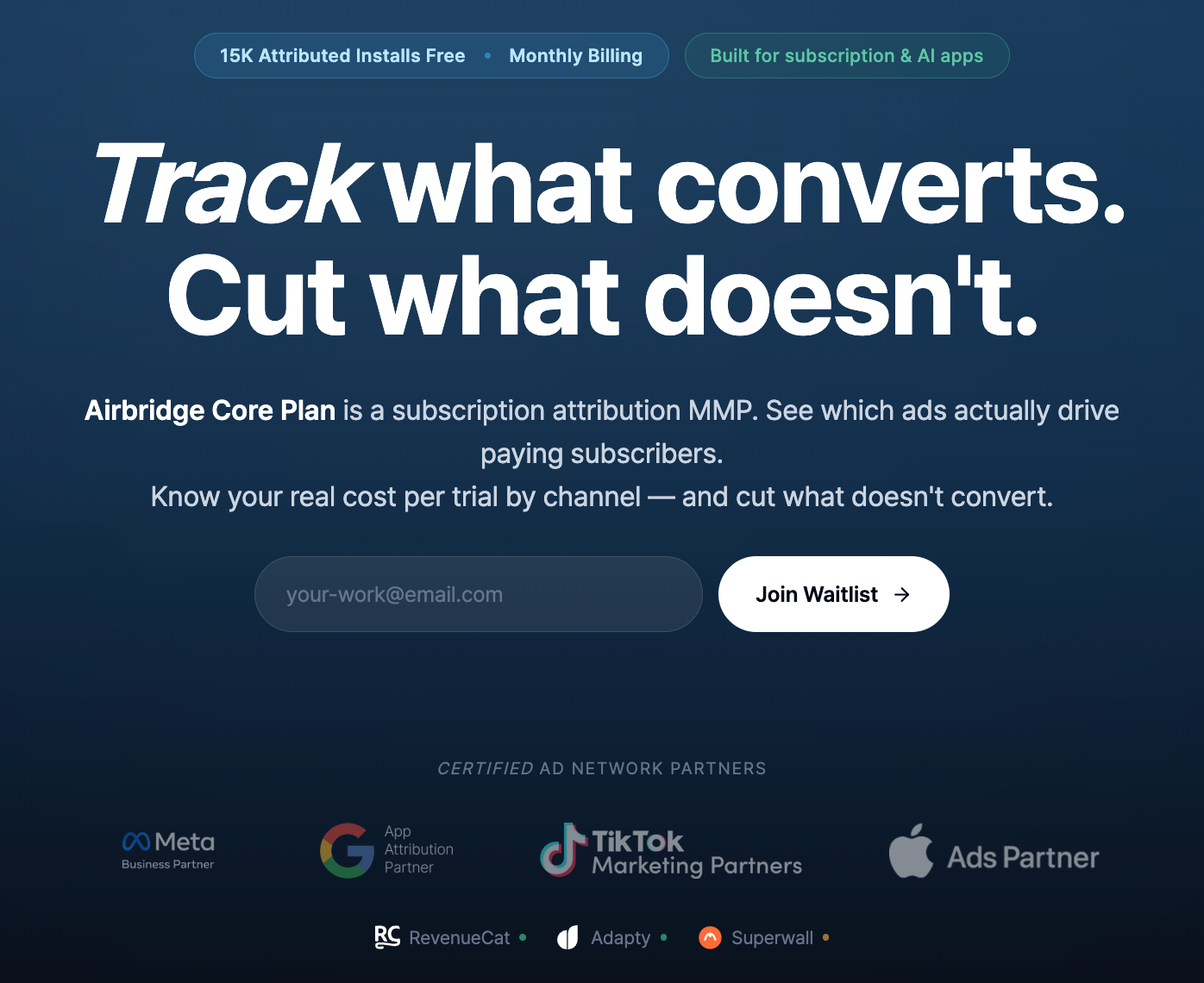
Airbridge Core Plan is the measurement layer that connects paywall, pricing, and trial experiments to channel-level outcomes:
- See which channels drive subscribers who convert at your paywall. Core Plan attributes Install, Start Trial, and Subscribe by channel — so you know whether a paywall change lifted conversions from Meta, Google, or Apple Search Ads.
- Evaluate pricing changes with real subscription data. The Actuals Report shows per-channel conversion rates at each funnel stage. When you change pricing, you can see which channels respond — instead of reading blended averages that hide the signal.
- Validate trial quality by channel. Are your TikTok trials converting to paid at the same rate as your Google trials? Core Plan shows trial-to-subscribe rates by channel, so you can distinguish signal from noise.
- Connect subscription data without custom event work. Native RevenueCat and Adapty integration via S2S sends subscription events into attribution automatically — no custom event setup, no engineering sprint.
Start with 15K free attributed installs. All features included. →
Sẵn sàng cách mạng hóa tăng trưởng mobile?
Tìm hiểu cách Airbridge giúp các thương hiệu hàng đầu đo lường và tối ưu mọi điểm chạm.