All About Mobile Measurement Partners (MMPs): Its Many Names and Definitions
7 phút đọc
Chia sẻ

Airbridge Pilot & MCP đã ra mắt.Khám phá phân tích marketing với AI.
Tìm hiểu thêmHỏi bất cứ điều gì về Airbridge
Câu trả lời được tạo bởi AI và có thể không hoàn toàn chính xác.
Cuộc trò chuyện có thể được ghi lại để cải thiện chất lượng.
Savvy app marketers use various tools to make data-driven decisions. Connecting a mobile attribution software to your app, in particular, helps you efficiently measure and optimize your campaigns. However, you might not be sure whether you’re using such a software due to its many names – MMP, mobile attribution provider, mobile app analytics software, third-party attribution platform, etc.
While all of these refer to the same concept of measuring marketing performance, there’s a variation because each name puts emphasis on different aspects of a mobile attribution software. Hence, understanding where these names come from can help you get a grasp of why you need to use one of these softwares for your app marketing success.
Let’s take a deep dive into the names, one by one.
The name “mobile attribution software” speaks for itself; it is a set of programs that is used to attribute, or to determine which touchpoint takes credit for each conversion. It collects user-level data to tie successful app events such as installs, sign-ups and purchases to the campaign or channel that created the engagement.
App marketers must have insights into how their actions impact revenue in order to improve their return on investment (ROI). They need to understand which activities performed better and why. With mobile attribution, you can measure and optimize marketing performance metrics in real time across different marketing channels, devices and ad networks.
There are different frameworks, or attribution models, for analyzing the value of a touchpoint in a conversion path. The last-touch attribution model, which gives 100% of the credit to the single last touchpoint, has been popular. However, as it doesn’t consider the earlier touchpoints that could have had an incremental impact, the multi-touch attribution model has become critically important.
Mobile Measurement Partners (MMPs) are a subgroup of Meta Business Partners that provide third-party measurement of mobile app ads through the installation of a Software Development Kit (SDK). The name has become so widely known that these days, it is no longer specific to Meta but is considered synonymous with a mobile attribution software that has integrated with the bigger networks like Self-Attributing Networks (SANs).
An MMP helps apps collect data on various events in the mobile environment to measure campaign performance and give credits to appropriate touchpoints. It should be noted that technically, only mobile attribution softwares that are in partnership with Meta are actual MMPs.
💡 Airbridge is the world’s first company to have been badged as Meta’s Mobile Measurement Partner as well as Multi-Touch Attribution Partner. Check out the details of the partnership here and Airbridge’s profile on Meta’s Partner Directory here.
The benefit of using an MMP is that it provides a unified overview of campaign data across multiple channels and networks, making it more convenient to compare results. For instance, with an MMP, you can analyze your ad performance from Facebook, Google, Apple, etc. whereas with the Facebook SDK, you can only measure Facebook ad performance. In addition, you can send in-app event data collected by an MMP to Facebook to use it for retargeting and optimization.
Furthermore, an MMP could lessen the burden if you’re using Apple’s SKAdNetwork (SKAN) to measure iOS 14.5+ app install campaigns. The SKAN postback includes conversion values that provide post-install information, and you can use an MMP to configure the app events to track. For Facebook, you can use the Facebook SDK or App Events API as well to import your event configuration schema to Meta.
👉 Find out more about configuring SKAN in Meta Events Manager
👉 Find out more about setting conversion values in Airbridge
You might be confused sometimes because your MMP and Meta Business Suite are showing different results. This usually happens if: your MMP and Facebook are using different attribution models; the attribution windows, or the time periods, are set differently; and/or your MMP and Facebook report conversion data at different times.
A mobile app analytics tool, in essence, serves the same purpose as a mobile attribution software. Both of them capture data on the way users interact with your app to help you see the consequences of changes and fine-tune your product at a granular level.
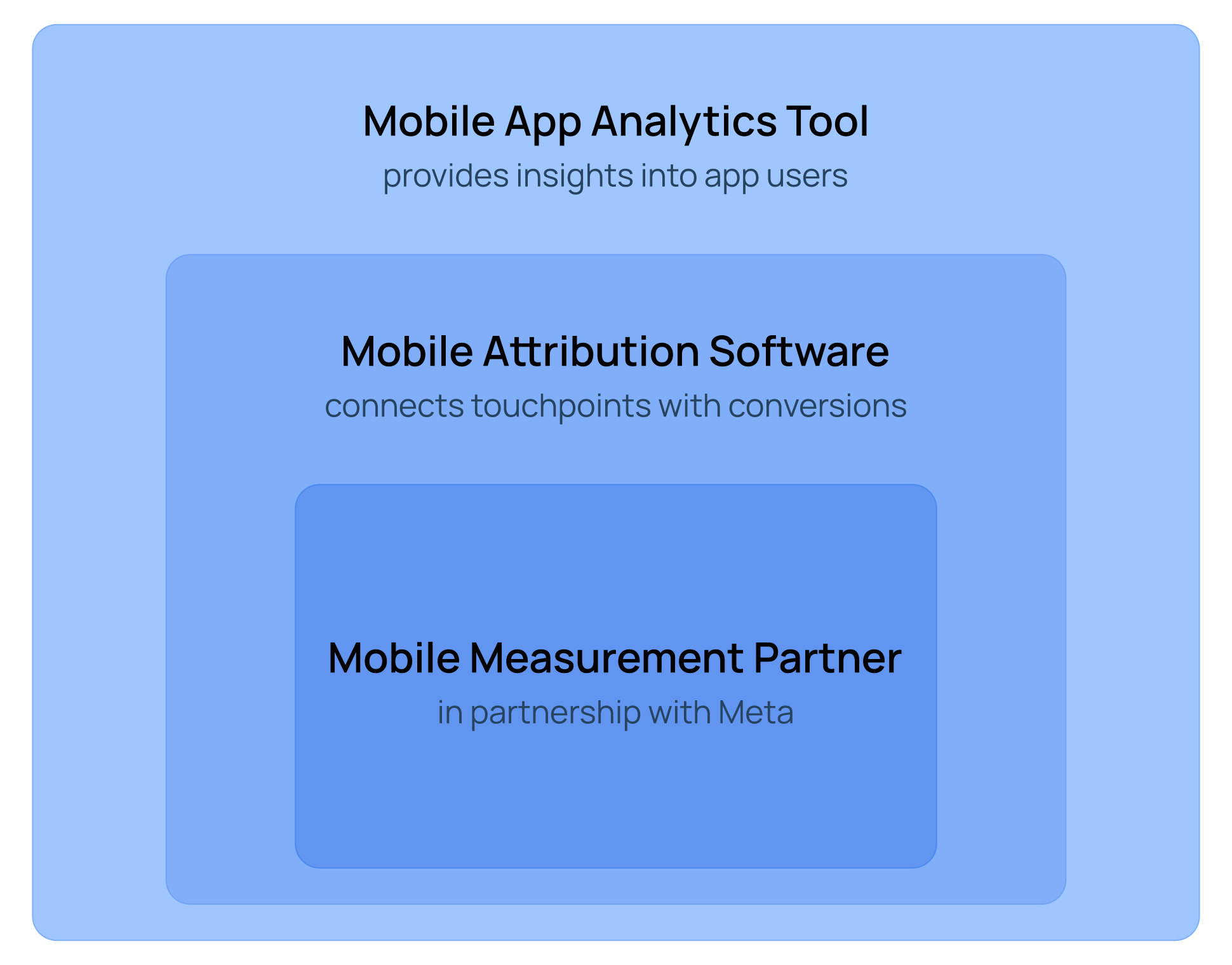
However, they should never be considered identical since mobile app analytics is the broader concept. It allows marketers to see what draws users to the app, how long visitors typically stay in the app, what factors are correlated with in-app events like purchases, and much more. On the other hand, mobile attribution is specifically focused on measuring where users come from by collecting touchpoint and conversion data.
As the diagram above shows, the three different terms explained so far should be categorized separately. This indicates that there are mobile app analytics tools that are not necessarily mobile attribution softwares, and mobile attribution softwares that are not MMPs.
Here are some examples of mobile app analytics tools:
Here are some examples of mobile attribution softwares:
Finally, here is a full list of Meta-badged Mobile Measurement Partners:
The name “third-party tracking platform” implies that it is an impartial observer that applies a single unified set of criteria to measure marketing performance across various channels. Although some ad networks provide attribution results themselves, it is important to involve a third-party due to three main reasons.
First, a third-party tracking platform allows you to take a holistic approach to marketing measurement. You might have had experiences creating a dashboard on Google Sheets to bring together results of different creatives and channels. While this could be tedious and time-consuming, the worst part is that you cannot be sure of the accuracy of your assessment if your attribution rules and marketing metrics are not standardized. Using a third-party tracking platform could help greatly with getting full performance visibility and identifying the true sources of growth. In fact, Airbridge is the only third-party tracking platform that has mastered unified web and mobile measurement, offering a comprehensive view of marketing performance from iOS, Android and desktop apps.
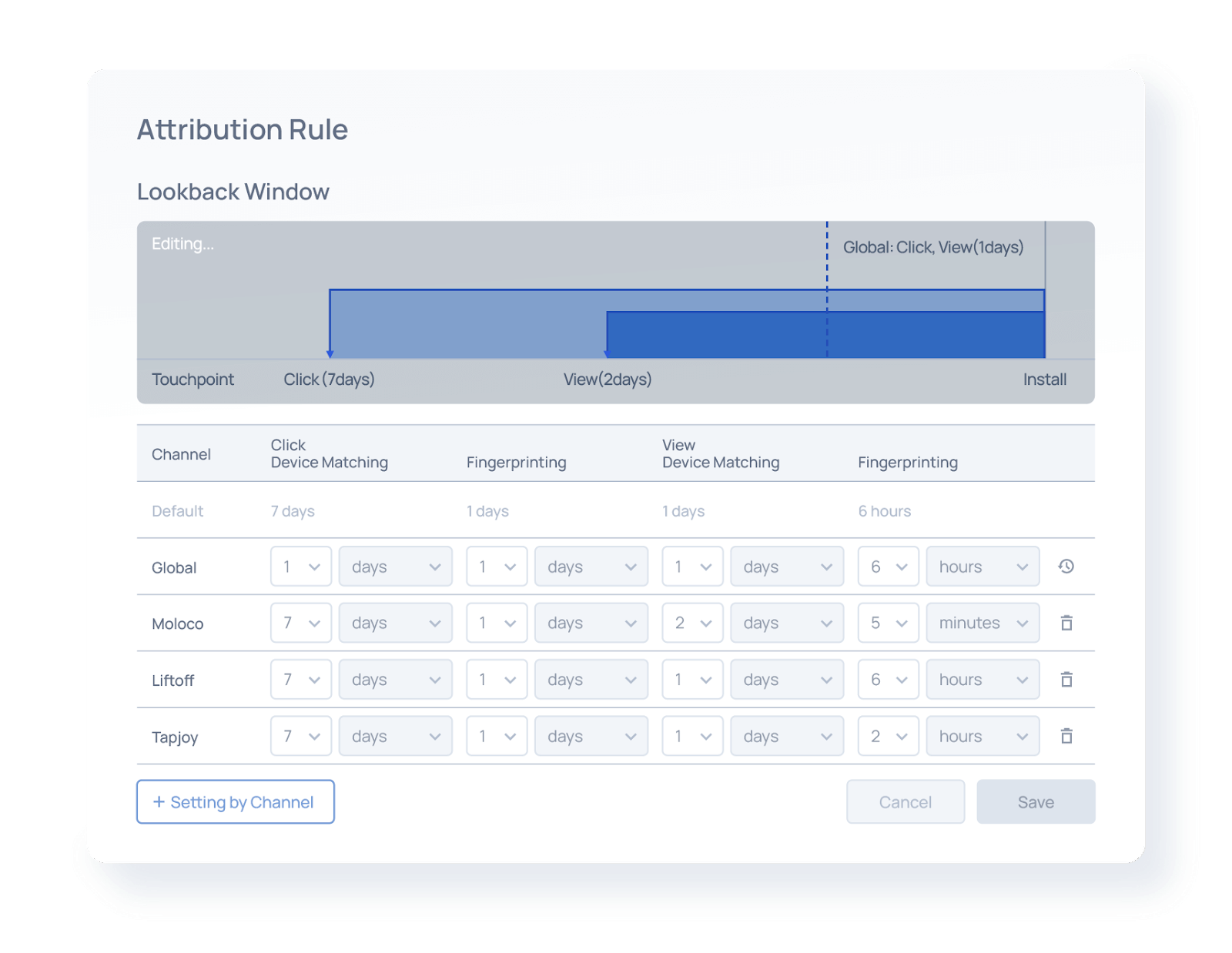
Airbridge Attribution Rule settings page
Second, mediation of a third-party guarantees objectivity and equitability across different channels. Let’s assume that an ad network is analyzing the performance of various ad networks including itself. Then there’s a high chance that it would draw conclusions in favor of itself to receive a larger sum from the total budget. However, if a third-party steps in, it becomes possible to calculate and settle ad spending more accurately. In addition, a third-party tracking platform can set fraud rules, effectively preventing and detecting any possible ad fraud.
Lastly, third-party tracking is suitable for responding to privacy changes. Apple’s iOS 14.5 update brought one of the most significant and controversial changes the industry has ever seen. Since April 2021, advertisers have been required to request consent before tracking user activity. Fortunately, third-party tracking platforms have come up with measures to deal with such situations and maintain marketing effectiveness. Airbridge, for instance, has introduced features related to deferred install tracking, simple automatic conversion values and conversion bits to adapt to the changes.
Airbridge is a mobile app analytics tool, a mobile attribution software, an MMP and a third-party tracking platform. By understanding what each term refers to, you can enhance your understanding of tools that provide you with actionable marketing insights.
If you are interested in building improvements and optimizing campaigns through web and mobile measurement, incrementality analysis and multi-touch attribution, Airbridge should be your choice of tool. Request a demo today!
Tìm hiểu cách Airbridge giúp các thương hiệu hàng đầu đo lường và tối ưu mọi điểm chạm.
Tiếp tục đọc các chủ đề liên quan.