Deferred Deeplink vs Standard Deep Link: What’s the Difference and Why Standard Isn't Enough in 2026?
Performance marketers know the frustration: a high-intent user clicks an ad, but the journey breaks because they don’t have the app installed.
If you’re relying solely on a deeplink strategy that doesn't account for the "install gap," you are likely burning your acquisition budget.
Understanding the nuance between a deferred deeplink vs standard deeplink is the difference between a bounced user and a high-value conversion.
📌Key Takeaway
- Standard deep links only work when the app is already installed. They break the moment an install is required.
- Deferred deep links preserve user intent even if the app isn’t installed. The intended destination is restored after install and first open.
- In real acquisition flows, install sits between click and conversion. Losing context at this stage leads directly to drop-off.
- Standard deep links fail in paid ads, web-to-app, referrals, and influencer traffic. Exactly where most new-user growth comes from.
- Deferred deep linking is no longer an upgrade, it’s the baseline. The requirement to turn installs into meaningful actions.
What Is a Deeplink?
A deeplink is a URL that routes users directly to a specific page or state inside a mobile app, instead of opening the app’s home screen or a mobile website. It’s used to shorten the path between intent and action.
Unlike web links or app store URLs, deeplinks use custom URL schemes (e.g., myapp://product/123) to trigger in-app navigation. They shine in campaigns – think ads, emails, or push notifications – bring users directly to specific in-app locations like a referral reward or personalized offer.
Learn more about Deep Linking Basics That Marketers and Developers Need to Know here.
Deferred deeplink vs Standard deeplink: Side-by-Side Comparison
To choose the right tool for your funnel, you must understand how these two technologies handle the user's "state" (whether the app is installed or not).
1) Standard Deep Links (The Ideal State)
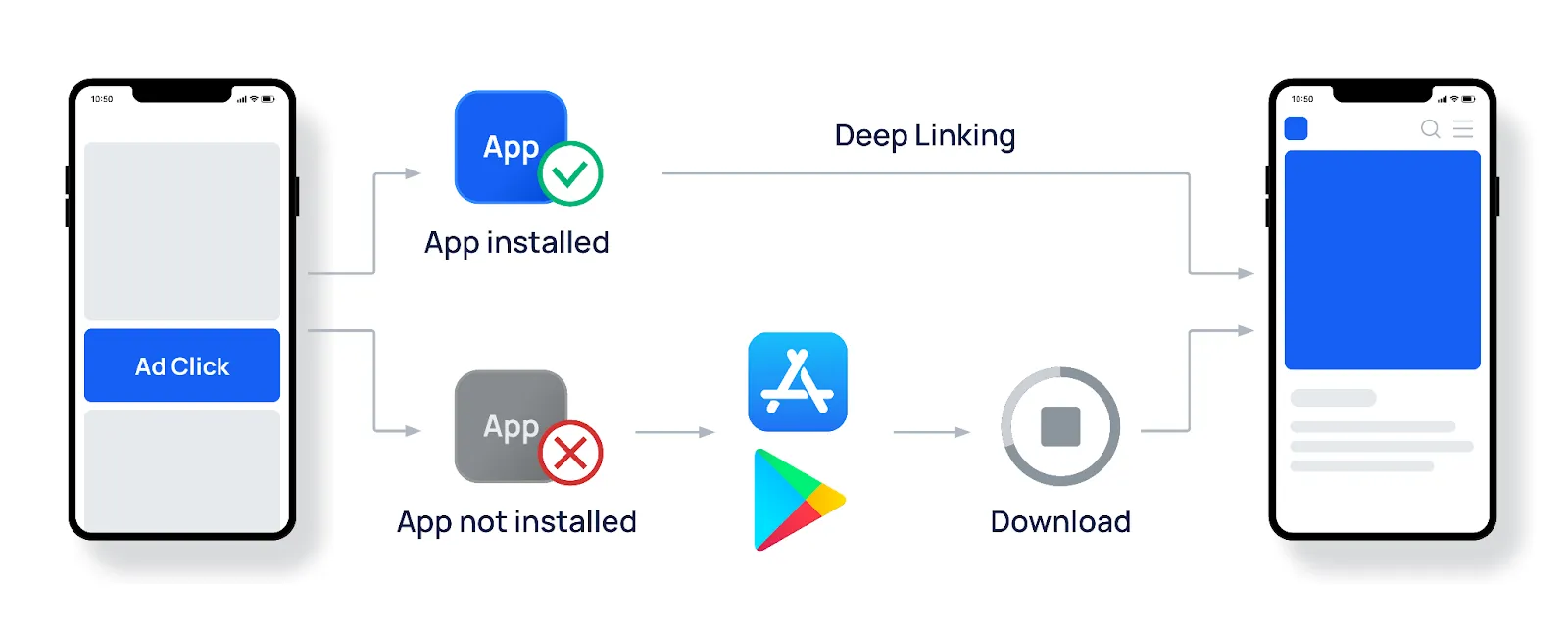
Standard deep linking (often utilizing Universal Links on iOS or App Links on Android) works only if the user already has the app on their phone. When clicked, the link checks for the app; if found, it opens the specific content immediately.
They rely on immediate URI handling – no install step. Pros: Fast, preserves all data.
But if the user does not have the app, a standard deep link typically fails. It either shows an error message or, at best, redirects the user to a mobile web version of the page. It cannot "wait" for the user to go to the App Store, download the app, and then find the original content.
2) Deferred Deep Links (The Real-World Solution)
Deferred deep links capture the user’s intent before install and restore it after the app is opened for the first time.
The flow looks like this:
- User clicks a link (ad, web, email)
- App is not installed
- User is sent to the app store
- After install, the app opens at the original destination
This is how acquisition actually works in the wild.
Deferred deep linking accounts for:
- New users coming from paid ads
- Platform interruptions (app store, privacy prompts)
- Multi-step journeys across web → store → app
A common mistake is treating deferred deep links as a “nice-to-have.” In reality, they’re the difference between measuring installs and driving meaningful post-install actions.
.comparison-table { width: 100%; border-collapse: collapse; font-family: 'Segoe UI', Tahoma, Geneva, Verdana, sans-serif; font-size: 15px; color: #333; margin: 20px 0; } .comparison-table th { background-color: #f8f9fa; text-align: left; padding: 15px; border: 1px solid #dee2e6; font-weight: 600; } .comparison-table td { padding: 15px; border: 1px solid #dee2e6; line-height: 1.4; } /* Optional: Light zebra striping for readability */ .comparison-table tr:nth-child(even) { background-color: #ffffff; }
Feature
Standard Deep Link
Deferred Deep Link
App installed
Opens the app to a specific in-app page
Opens the app to the intended in-app page
App not installed
Fails or redirects to app store without context
Routes user to app store, then restores destination after install
Post-install experience
No context preserved
Original intent fully retained
Paid acquisition support
Limited
Designed for paid channels
User journey continuity
Fragile
Seamless
Conversion impact
High drop-off risk
Higher install-to-action rate
Why "Standard" Isn't Enough for Performance Marketing in 2026
In 2026, the cost of user acquisition has skyrocketed, with CPMs increasing faster than average revenue. Relying solely on standard deep links for new user acquisition is essentially paying for clicks that are designed to fail when acquisition paths include installs, privacy gates, and multiple platforms.
Here is why "Standard" Isn't Enough for Performance Marketing in 2026:
1) The Acquisition Funnel Is No Longer Linear
In practice, a single “click → open app” flow rarely exists.
A typical journey now looks like this:
- Ad click on mobile web
- Redirect through tracking or privacy layers
- App store visit
- Install confirmation
- First app open
- Permission prompts
- Finally, content
Standard deeplinks don’t survive this sequence. They weren’t designed to.
Once the user is sent to the app store, the link context is gone. By the time the app opens, the system has no idea why the user came.
2) Install ≠ Conversion
A common reporting mistake is treating installs as success.
What actually matters:
- Completed signup
- Viewed product page
- Triggered purchase
- Activated key feature
Without deferred deep linking, users land on the default home screen after install. From there, they must re-discover what motivated them in the first place.
Drop-off here is invisible in many dashboards – but very real in revenue.
3) Privacy and Platform Changes Make It Worse
OS-level privacy updates and browser restrictions have made attribution and routing more fragile.
Examples:
- App Tracking Transparency interruptions
- Browser-to-app handoff inconsistencies
- Webview and in-app browser limitations
Standard deeplinks rely heavily on OS behavior staying predictable. That’s no longer a safe bet.
Deferred deep linking adds a persistence layer that absorbs these disruptions instead of breaking under them.
When Should You Use Deferred Deep Linking?
Use deferred deep linking whenever your campaign targets new installs or mixes installed/non-installed users. It bridges the install gap, preserving context like campaign IDs or product SKUs for post-install routing.
App publishers lean on it for UA ads, where standard links fail 70% of the time. A common mistake: skipping it for email flows – yet even re-engagement benefits if users reinstall.
Checklist: When Deferred Beats Standard
- Running CPI/CPA ads with install-first flows.
- Cross-platform campaigns (store redirects common).
- Personalized onboarding.
- High churn funnels needing D1 retention lifts.
- Attribution across MMPs amid ATT/WebView limits.
Airbridge DeepLink: Maximum Conversion by Seamless User Journey
Airbridge provides an enterprise-grade but start-up budget deep linking solution that eliminates the friction between a click and a conversion.
While standard tools provide basic routing, Airbridge ensures that your attribution data and user experience remain intact across the entire "Install Gap".
Airbridge DeepLink supports:
- Web-to-app: Convert web traffic to app users, seamlessly landing them on specific pages within the app with web-to-app CTA buttons like “Open in app”
- CRM-to-app: Embed DeepLinks in your email, SMS, and push notifications, and direct users straight to the specific app page.
- Offline-to-app: Whether it’s TV ads, brochures, billboard banners, event signage, or product packaging, QR codes with Airbridge deep links will send users directly to targeted content within the app.
- Social-to-app: Users are sent directly to in-app content after installation – not the home page.
- Influencer & Affiliates: Distribute short links and QR codes to each influencer so that you can analyze which performs the best
- Referral: Scale your referral campaigns with API-generated DeepLinks, directing users to targeted signup flows or exclusive in-app offers.
More importantly, it’s built to remain stable despite:
- OS updates
- Privacy restrictions
- Multi-touch attribution models
Outro.
Standard deep links worked in simpler times. But with fragmented funnels, privacy hurdles, and sky-high acquisition costs, they leave too much revenue on the table.
Deferred deep links fix this by preserving intent across the install gap – turning more installs into signups, purchases, and activations. Performance marketers who ignore this baseline risk watching competitors pull ahead.
In practice, teams using deferred deep links see 20-40% lifts in D1 retention and post-install conversions. A common mistake? Sticking to basic tools that crumble under real-world pressure.
Ready to stop losing high-intent users? Airbridge DeepLink makes seamless journeys effortless – handling web-to-app, CRM, offline QR codes, and more, all attribution-ready.
👉Read to perfect every link and scale every campaign?
👉 Explore how real teams are scaling deeplinking with Airbridge:
How Dabang cut deep link management time by 90% with Airbridge
How Fizz achieves ZERO performance loss with Airbridge API deeplinks
모바일 성장을 혁신할 준비가 되셨나요?
에어브릿지가 선도 기업의 모든 터치포인트를 측정하고 최적화하는 방법을 알아보세요.